
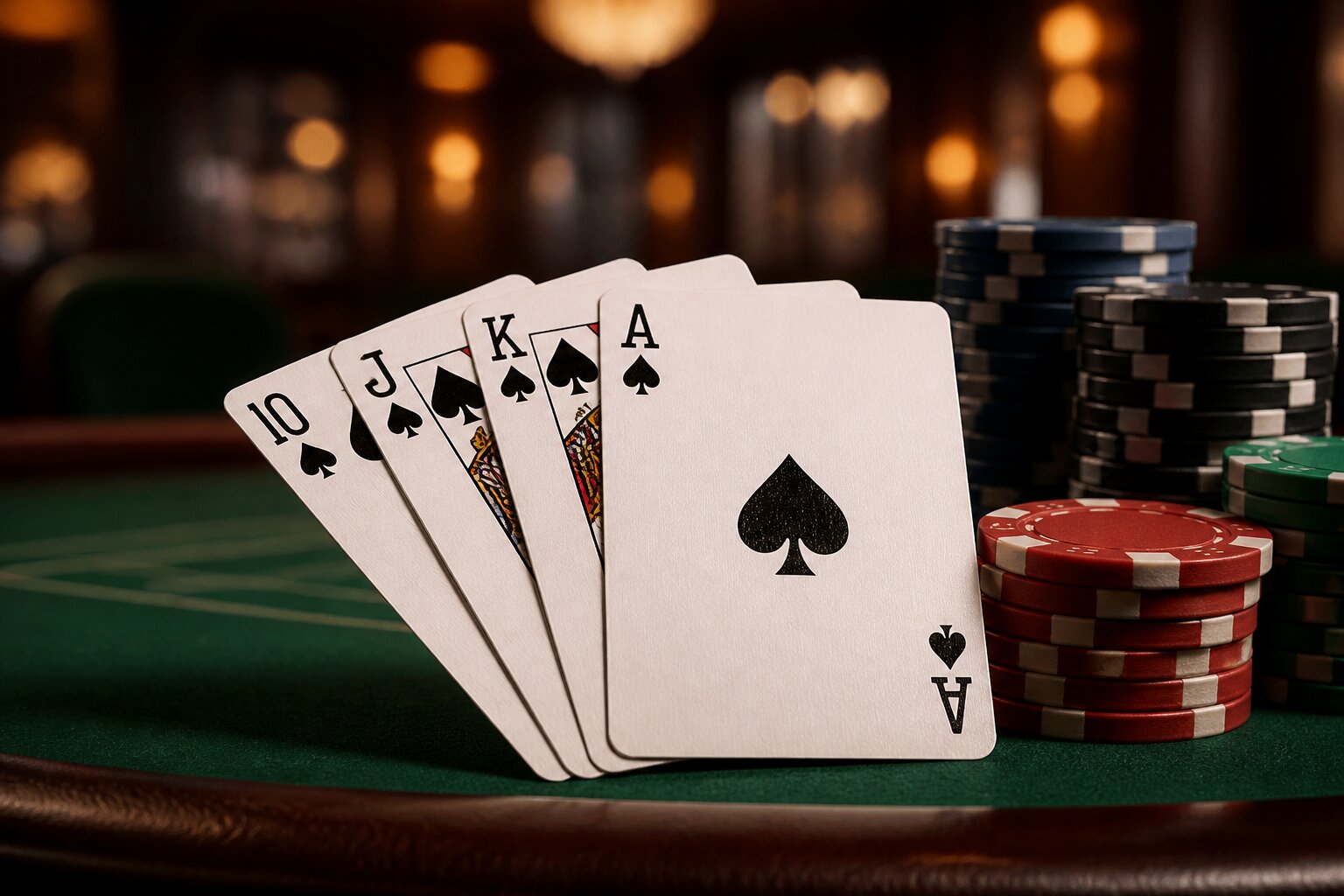
Ever found yourself at a casino table and overheard someone mention a “straight flush” while playing blackjack? It can make you do a double-take. Isn’t that a poker hand? If you’ve played both blackjack and poker, you’ll recognise the thrill of a straight flush in poker, but when the term pops up at a blackjack table it usually points to a side bet that borrows poker-style combinations.
Blackjack remains one of the UK’s most played card games because the rules are direct and the action is brisk. Recently, many venues and online tables have added optional side bets to create extra moments of excitement, and that is where poker-style hands such as straight flushes appear.
This article explains what a straight flush means in blackjack, how those side bets work in practice, and how the idea compares with a straight flush in poker, so you can decide whether these extras are worth a punt. Read on to learn how the side bet resolves and how its place at the table differs from poker’s core gameplay.
What Is a Straight Flush in Blackjack?
In blackjack, a straight flush is not part of the main game outcome. Instead, it is a special combination used by optional side bets that some tables offer to add variation. The combination is three consecutive cards of the same suit: your two initial cards plus the dealer’s face-up card.
For instance, if you receive the 7 and 8 of hearts and the dealer shows the 9 of hearts, those three cards form a straight flush. The sequence must be direct, so examples include 7, 8, 9 of the same suit or 10, jack, queen of the same suit. Importantly, the side bet is evaluated immediately from that initial trio; nothing that happens later in the hand affects it.
Because the combination uses just the two player cards and the dealer’s up card, it is resolved as soon as the deal happens. That immediacy gives the side bet its appeal and explains why casinos often place attractive payouts on it. The next section shows what placing and resolving the side bet looks like in play.
How Is Straight Flush Blackjack Played?
Playing with a straight flush side bet begins like any blackjack hand: a standard wager is placed for the main game, and if offered, an optional side bet may be put down before cards are dealt. The side bet stands apart from the main stake and is settled on the initial three-card combination alone.
After bets are placed, the dealer deals two cards to the player and one face-up card to themselves. At that instant the casino checks the three cards. If they are sequential and share the same suit, the side bet pays according to the table’s paytable. For example, a £5 side bet that wins might return a multiple of that stake depending on the listed odds.
Once the side bet has been resolved, play continues with the standard blackjack decisions and outcomes for the main wager. Because rules and payouts can differ between operators, it is sensible to consult the paytable before committing to the side bet. The following section outlines the typical rules and the kinds of payouts you can expect.
Key Rules & Payouts
The qualifying condition is simple: your first two cards and the dealer’s up card must be three consecutive cards of the same suit. No further actions affect this result. Payouts tend to be generous compared to common blackjack outcomes because the probability of such a combination is low.
A typical payout often cited for a straight flush side bet is 40:1, meaning a £1 side bet would return £40 in winnings plus the original £1 stake. Some venues present slightly different odds, for example 30:1 or 50:1, so checking the table’s paytable is essential. Other side bets on the same table may pay for straights without the same-suit requirement or for three-of-a-kind, usually at lower multiples.
Only one clear reminder is included here: treat side bets as optional entertainment rather than a core strategy, and limit stakes to amounts you are comfortable losing. With the rules and payout context in mind, it helps to compare how these poker-style outcomes fit into the broader differences between blackjack and poker.
Blackjack vs Poker: Major Differences
Hand Values
In blackjack, card values have numeric values that combine toward a target total of 21. A straight flush is not a standard winning condition in the main game, but it can pay via side bets. In poker, by contrast, hand rankings determine the winner; a straight flush is one of the highest-ranked hands and is directly decisive in play.
Gameplay Purpose
Blackjack pits each player against the dealer, with the objective of achieving a stronger total without exceeding 21. Poker focuses on competing against other players, using both card combinations and betting to prevail.
Ways to Win
Blackjack outcomes depend on the final totals and dealer busts, while poker outcomes are decided by the comparative rank of hands at showdown or by betting strategy. Side bets introduce poker-style rewards into blackjack, but they operate separately from the main contest of 21.
House Edge
The main blackjack game carries a known house edge that can be reduced with correct play. Side bets, including those that reward straight flushes, generally raise the house edge because their payouts reflect the low probability of the event. Poker does not impose an odds-based house advantage on card outcomes; instead, venues take a rake, a fee removed from each pot.
Card Combinations
A straight flush in blackjack side bets uses only the two player cards and the dealer’s up card, and it is decided immediately. In poker, a straight flush is formed from five cards and typically appears only after the full deal or at showdown.
Having established these structural contrasts, the next section looks specifically at how hand rankings differ and how the shared equipment, namely the deck, is used differently in each game.
Comparison of Hand Rankings Between Blackjack and Poker
Hand rankings are central to poker but largely irrelevant to standard blackjack outcomes. Poker players construct a five-card combination, and the ranking system—from high card up to royal flush—determines winners. Blackjack ignores those rankings, instead measuring proximity to the number 21.
A royal flush in poker, the highest possible five-card suited sequence from ten to ace, is extremely rare and beats every other hand. Poker also recognises full houses, straights and three-of-a-kind as graded categories. Blackjack’s premium result remains a two-card “blackjack” comprising an ace and any ten-point card, which is rewarded separately from poker-style hands.
Why Do Hand Rankings Differ in Each Game?
The two games pursue different objectives. Poker rewards specific card patterns and strategic play over successive betting rounds. Blackjack is arithmetic-focused: the priority is to reach or approach 21 and to outscore the dealer. Side bets that acknowledge poker hands exist to borrow the drama of those patterns without changing blackjack’s core aim.
Do Blackjack and Poker Use the Same Decks?
Both games usually use a standard 52-card deck without jokers, but the number of decks and how they are managed differ. Poker tables generally rely on a single deck per deal, while blackjack can use multiple decks, sometimes up to eight, especially in casino environments and electronic shufflers. Multiple decks in blackjack increase card supply and reduce the practicality of card-counting techniques. With the deck usage and ranking differences covered, it is useful to see the common side-bet formats that bring straight flushes into blackjack.
Popular Variations Featuring Straight Flushes
21+3 Blackjack
21+3 is the most common side-bet format that rewards poker-style combinations. It evaluates the player’s first two cards and the dealer’s up card as a three-card mini-hand, paying out for straights, flushes, three-of-a-kind and straight flushes. For example, a player holding the 6 and 7 of clubs with the dealer showing the 8 of clubs would qualify for a straight flush payout. The result is checked immediately after the deal.
Perfect Pairs + 21+3
Some tables combine Perfect Pairs and 21+3, allowing players to wager on both possibilities at once. Perfect Pairs rewards matching ranks or suits in the player’s two cards, while the 21+3 portion covers the three-card poker-like combinations. A hand such as 4 of hearts and 5 of hearts with the dealer showing 6 of hearts would be a 21+3 straight flush winner while also possibly qualifying under Perfect Pairs criteria, depending on the specific paytable.
Across these variations, paytables and rules differ from operator to operator, so checking the posted payouts clarifies the likely returns. Side bets add a distinct flavour to the table without affecting the core blackjack play that follows, and that completes the look at how straight flushes migrate from poker into blackjack-style betting.
This brings the topic full circle: straight flushes in blackjack are rare, resolved instantly as part of optional side bets, and designed to add short bursts of excitement rather than alter the fundamental game of 21.
Enjoy Table Games at Freebet Casino
Explore a world of entertainment with us, where you will find plenty of choice and something for everyone. We invite you to enjoy the variety on offer at our site in a friendly and welcoming environment.
Creating an account is simple, and once you have made a deposit, you can start enjoying our games. We look forward to having you with us.
**The information provided in this blog is intended for educational purposes and should not be construed as betting advice or a guarantee of success. Always gamble responsibly.