
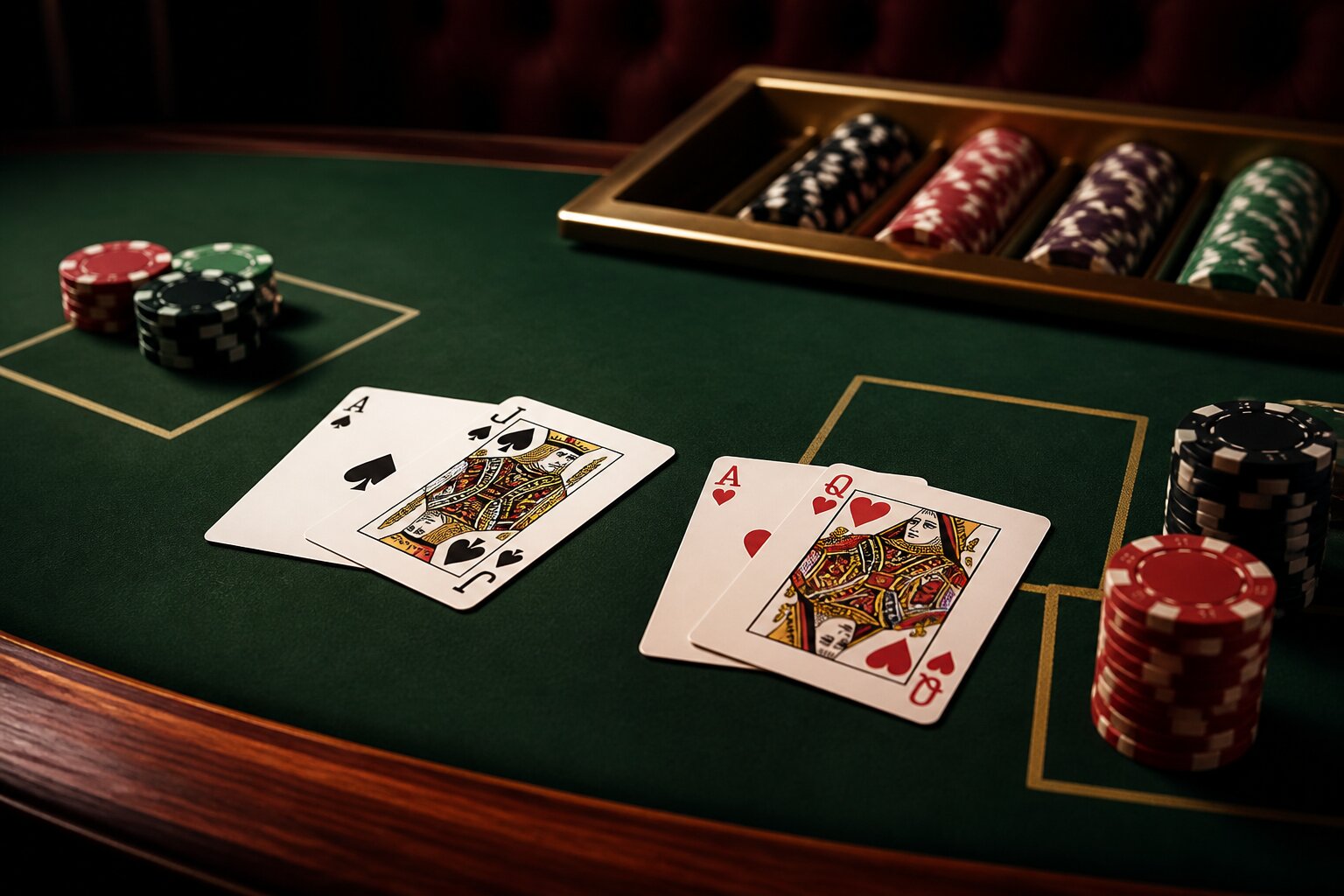
Thinking of playing blackjack but not sure how the cards add up? You’re not alone. Whether it’s your first time at a table or you’re trying an online game, knowing how card values work makes each decision clearer and less stressful.
This guide explains how every card contributes to a hand, how totals are worked out, and what those terms like “soft” and “hard” actually mean. Read on to get a solid grasp of the basics and feel more confident when you next sit down to play.
What Are the Standard Card Values in Blackjack?
Each card in blackjack carries a fixed value that you use to total your hand. Knowing these values lets you work out whether your hand is strong or if you should take another card.
- Number cards (2–10) are worth their face value. A 5 is five points, an 8 is eight points.
- Face cards—Jack, Queen and King—are worth 10 points each.
- An Ace can count as either 1 or 11, depending on which value keeps your total in the best position.
The Ace’s flexibility creates two types of hands: soft hands and hard hands. A soft hand includes an Ace counted as 11, so it cannot bust with one additional card. For example, Ace plus 6 is a soft 17. A hard hand either has no Ace or has an Ace counted as 1, so the risk of busting is higher.
If your total goes over 21 you bust and lose that round. With these values in mind you can quickly add any hand and judge whether to take another card or stand. Simple practice with a few sample hands will make this counting second nature.
How Do Face Cards and Aces Work in Blackjack?
Face cards are straightforward:
- Jacks, Queens and Kings always count as 10 points.
- If you have two face cards, your hand is worth 20.
Aces are the flexible element. They can count as either 11 or 1 depending on which gives the best total without exceeding 21.
For example, an Ace and a 6 can be treated as 17. If you draw a further card that would push that total above 21, the Ace will instead be valued as 1 so the hand stays in play.
When you have more than one Ace the values adjust to avoid busting where possible. For instance, two Aces and a 9 are scored as 11 + 1 + 9, giving 21 rather than 31.
That adaptable Ace is why some decisions feel less final until you see the full hand. Understanding this flexibility helps you judge risk and opportunity as a round unfolds.
Understanding Hand Values in Blackjack
The aim in blackjack is to have a total as near to 21 as possible without going over. How you reach that total is simply a matter of adding the values of the cards you hold.
Cards are worth the following:
- Numbered cards count at their face value.
- Face cards (Jack, Queen, King) each count as 10.
- An Ace can count as either 1 or 11, depending on which is more favourable for the hand.
Practising basic totals makes the game smoother. Familiar combinations—such as 10 with a 7 (a hard 17), or Ace plus 9 (a soft 20)—become easier to recognise. That quick recognition helps you weigh your options during play and reduces the chance of making hurried mistakes.
How to Calculate Your Hand Total
Start by adding the face values of each card. If the hand contains an Ace, follow a simple approach to decide its value:
- Treat the Ace as 11 to begin with.
- If the total exceeds 21, reduce the Ace from 11 to 1.
- If you have more than one Ace, repeat the adjustment as needed until the total is 21 or less, or until all Aces are counted as 1.
For example, a hand of Ace, 5 and 9 initially reads as 25 when the Ace is counted as 11. Reducing the Ace to 1 makes the total 15. This automatic adjustment keeps hands valid as cards are added and helps prevent an unnecessary bust.
What Is a Soft Hand vs Hard Hand in Blackjack?
Hands are described as soft or hard mainly because of how an Ace is counted.
A soft hand includes an Ace being valued as 11. That gives the hand an extra buffer, since the Ace can drop to 1 if needed. For instance, Ace + 4 is a soft 15.
A hard hand either has no Ace or has an Ace that counts only as 1. A hard 17 could be a 10 and a 7, or a hand where an Ace has already been reduced to 1 because of other cards. The difference between soft and hard affects how aggressive or cautious players tend to be with taking more cards.
How Are Pairs and Splits Valued?
When your first two cards are the same value, that’s a pair and you’re often allowed to split them into two separate hands. You place an additional bet to play both hands independently.
Each new hand is scored in the same way as any other. If you split two 8s, for example, each 8 will receive another card and become a regular two-card hand to be played on its own. If you split two Aces, many casinos will deal only one extra card to each Ace.
Splitting doubles the amount you have in play, so it’s worth considering your budget and how the new hands might be positioned against the dealer before deciding.
Common Misconceptions About Blackjack Card Values
There are a few recurring misunderstandings that can confuse new players.
Some people think an Ace always counts as 11; in practice it flips to 1 when that keeps the hand under 21. Others assume face cards have varying values, but Jacks, Queens and Kings are always worth 10. Suits are irrelevant in blackjack—the game cares only about the numbers (and Aces’ dual value).
Also, no particular card or sequence can guarantee an outcome. Each deal is independent and outcomes come from how totals compare once a round finishes.
If anything here sounds familiar from earlier sections, that’s because the same basic facts—card values and Ace flexibility—underpin most choices at the table.
Blackjack Card Values: Frequently Asked Questions
Below are concise answers to questions players commonly ask about card values.
What Is the Value of a Jack, Queen, or King?
Each face card—Jack, Queen, King—is worth 10 points.
Can an Ace Be Both 1 and 11 at the Same Time?
An Ace cannot be counted as both values simultaneously. It’s used as either 11 or 1 in the same hand, depending on which value keeps the total below or equal to 21.
Are Jokers Used in Blackjack?
No. Standard blackjack uses a 52-card deck without Jokers.
How Many Cards Can I Have in My Hand?
There’s no fixed limit on the number of cards, but if the total exceeds 21 the hand ends for that round.
Does the Suit of a Card Matter?
No. Suits have no effect on blackjack hand values.
If you’re unsure about any specific rule at a table, check the house rules before you play and always keep your stakes within a level you’re comfortable with.
**The information provided in this blog is intended for educational purposes and should not be construed as betting advice or a guarantee of success. Always gamble responsibly.