
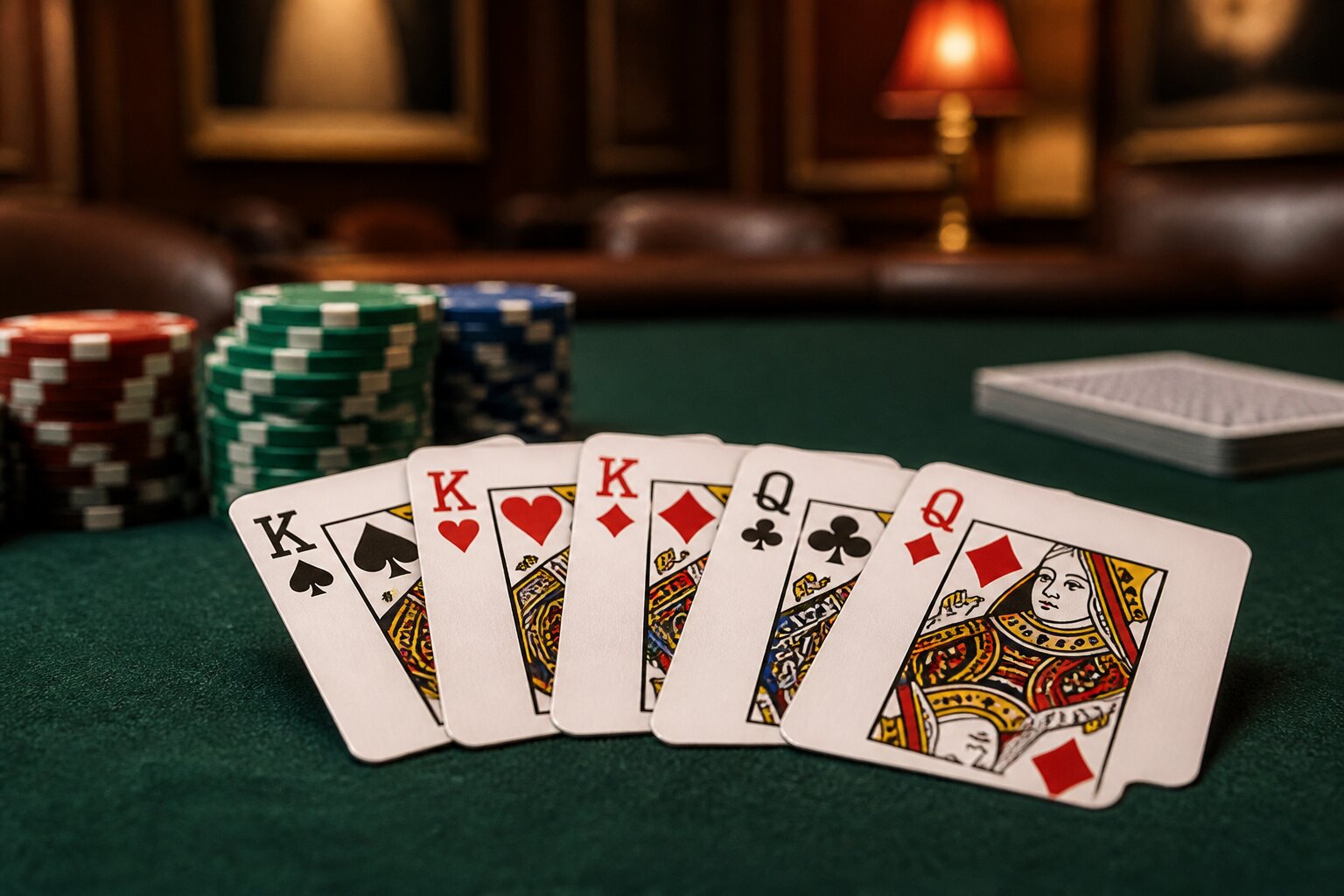
If you’ve ever watched a poker game or played a hand yourself, you’ll often hear the term “full house” called out at the table. It’s one of the stronger hands, and knowing how it’s built and where it sits in the rankings makes reading a game much easier.
This guide explains exactly what a full house is, how it compares with other hands, and gives clear examples so you can recognise it in play.
Ready to get into the details? We’ll start with the simple definition and then build out from there.
What Does a Full House Consist Of?
A full house is a five-card hand made up of two groups: three cards of the same rank and two cards of another matching rank. Think of it as three of a kind plus a pair, all in the same five-card combination.
For instance, K♠ K♥ K♦ 5♣ 5♠ is “Kings full of fives.” Likewise, 8♣ 8♦ 8♥ J♠ J♦ is “Eights full of jacks.” Suits don’t matter here — only the ranks do. That means the three matching cards can be any mix of suits, as can the pair.
Once you can spot three matching ranks and a separate pair within five cards, you’ve identified a full house.
When you understand this structure, it becomes easier to see why full houses beat hands like flushes and straights, which we’ll cover next.
How Does a Full House Rank Among Poker Hands?
In standard poker rankings a full house sits high on the list. Only four of a kind, straight flush and royal flush are ranked above it; everything from a flush downwards is below it.
From highest to lowest, the relevant section of the ranking looks like this:
- Four of a Kind
- Full House
- Flush
- Straight
- Three of a Kind
When two players both hold a full house, the one with the higher three-of-a-kind portion wins. For example, A♠ A♥ A♦ 6♣ 6♦ beats Q♠ Q♥ Q♦ J♣ J♦ because three aces outrank three queens. If the three-of-a-kind ranks are identical, the pair is used to break ties.
Having this ranking in mind helps when you’re assessing how strong a full house is in a particular pot.
Common Full House Examples
Full houses can be constructed from any ranks, so there are many combinations you might encounter. Here are some commonly seen and easy-to-visualise examples:
- A♠ A♥ A♦ K♣ K♦ — “Aces full of kings.” One of the strongest full houses.
- K♠ K♦ K♣ J♦ J♠ — “Kings full of jacks.”
- 10♥ 10♣ 10♦ 2♣ 2♦ — “Tens full of twos.”
- 9♠ 9♥ 9♦ 8♣ 8♥ — “Nines full of eights.”
These examples show the same pattern: three matching ranks plus a separate matching pair. The particular ranks determine how strong the hand is relative to other full houses.
The next section looks at how often you’ll actually see a full house in play, which helps put these examples into real-game perspective.
How Rare Is a Full House in Poker?
Full houses are uncommon compared with simple pairs or two pairs. In five-card poker, being dealt a full house straight away happens roughly once in every 694 hands — a small but not vanishing frequency.
In Texas Hold’em, players use up to seven cards (two private cards and five community cards) to make the best five-card hand. Because there are more cards to combine, full houses show up more often by the river than in a strict five-card draw. Exact probabilities shift with the number of players and the way the board develops, but full houses remain noticeably less frequent than hands such as pairs or two pairs.
Knowing the relative rarity helps explain why full houses are treated seriously at the table: they’re strong, but not so infrequent that you can assume they’re unbeatable.
Full House vs Other Strong Hands: Key Differences
It helps to compare a full house with other high-ranking hands to see what makes it distinct.
Four of a kind contains four cards of the same rank plus one unrelated card, which places it above a full house. A flush requires five cards of the same suit, irrespective of rank, and sits below a full house. A straight is five consecutive ranks in any suits and ranks lower than a full house as well.
What separates a full house is its mixed structure — three of a kind combined with a pair — so it’s stronger than any hand that relies solely on suits or runs of ranks.
Understanding these structural differences lets you judge a hand’s strength more accurately during a hand.
Do Suits Matter in a Full House?
No — suits have no bearing on a full house. The ranking is determined only by the face values or numbers of the cards involved.
That could mean three hearts and two spades, three clubs and two diamonds, or any other suit mix; as long as the ranks form a three-of-a-kind and a pair, the hand qualifies as a full house. This is why you’ll often hear full houses described solely by their ranks — for example, “eights full of jacks” — with no mention of suits.
This focus on rank rather than suit is part of what separates full houses from hands like flushes.
Full House Myths Explained
A few misconceptions about full houses come up repeatedly, so it’s useful to clear them up.
One myth is that a full house is unbeatable. In reality, four of a kind, straight flush and royal flush can still beat it. Another incorrect idea is that suits affect the strength of a full house; they do not, since the hand depends only on ranks. Finally, some players assume a full house always wins a showdown, but equal full houses are resolved by comparing the three-of-a-kind ranks first and then the pair if needed.
Keeping these facts straight helps avoid costly assumptions at the table.
Summary: Key Facts About Full Houses in Poker
A full house consists of three cards of one rank and two of another, and it ranks above flushes but below four of a kind. Suits don’t matter; only the ranks do. Full houses are less common than many hands you’ll see, which is why they command respect when they appear. When two players hold full houses, the higher three-of-a-kind determines the winner.
If the game ever stops being enjoyable, it’s wise to take a break and seek support. Playing within your limits and knowing how hands work are the best ways to keep poker clear and enjoyable.
**The information provided in this blog is intended for educational purposes and should not be construed as betting advice or a guarantee of success. Always gamble responsibly.