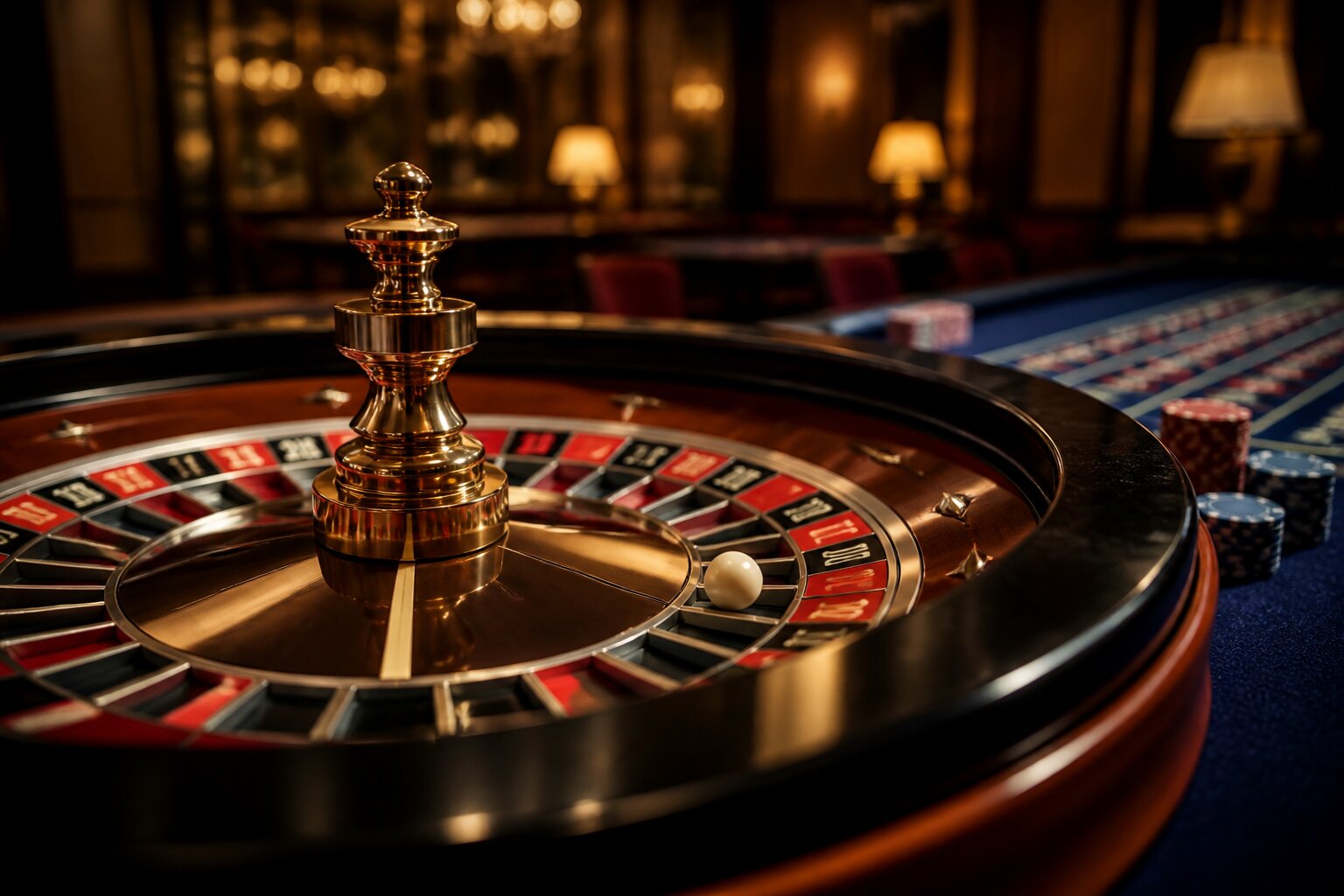
Ever sat at a roulette table and watched the same number pop up twice in quick succession? That flutter of excitement, and the sudden urge to act on a pattern you think you’ve spotted, is a common reaction for many players.
It’s easy to imagine that repeating numbers hold a secret, a way to outguess the wheel. But beyond the buzz of the table, the reality is governed by mathematics and design rather than any memory or pattern that can be exploited.
Read on to separate fact from folklore, understand the true odds behind repeats, and see what that means if you’re tempted to follow a streak.
Do Repeating Numbers Really Happen in Roulette?
Yes — repeating numbers occur, but they are simply one of the many possible outcomes in a random process. In European roulette there are 37 pockets (1–36 and a single zero), so a straight-up bet on any specific number has a 1 in 37 chance on each spin. Multiply that for consecutive hits: the same number twice in a row is 1/37 × 1/37, and three times is 1/37 cubed. Those probabilities make repeats rare, but not impossible.
Because so many spins take place in casinos and online, observers will sometimes see repeats purely by chance. This does not imply a pattern that can be used to predict future results — every spin is a separate event with the same mathematical likelihood. The important point is that occasional repeats are naturally expected in a random system, and they do not indicate any change to the underlying odds.
If you want to dig into why those odds matter for betting choices, the next section looks at the common strategies that try to exploit repeats and why they don’t change the mathematics.
The Truth About "Repeating Number" Strategies
Strategies that focus on repeating numbers usually start from an appealing but incorrect belief: that once a number or a run of numbers appears, it somehow becomes more or less likely to show up again. Players may double bets on a recent winner, spread stakes across a set of recent results, or follow a board of past spins in the hope of spotting a trend.
None of these approaches affect the house edge or change the probability for any single spin. Whether a number has just landed or hasn’t appeared for many spins, the chance of it landing next is still 1 in 37 in European roulette. Tracking past results can be absorbing and provide a structure for a session, but it does not give predictive power.
These systems can also encourage changes in bet size that increase short-term variance and the potential for losses. Treating number repeats as an exploitable pattern is a misunderstanding of independent events; the wheel’s design and the rules of probability ensure that outcomes do not carry over from one spin to the next.
Myth: A number is “due” after not appearing for many spins
There is no mechanical or mathematical reason for a number to be considered “due”. Each spin is an independent event with the same probability for every pocket, so a long absence does not make a future appearance any more likely.
Thinking a number is due is a classic example of misunderstanding independent events. Even after many spins without a particular result, the probability on the next spin remains unchanged.
Myth: If a number repeats, it becomes more likely to appear again
A repeat is simply a coincidence, not a predictive signal. The wheel has no memory and no way of storing past outcomes, so a number’s previous appearances do not influence what happens next.
Seeing the same number several times can feel meaningful, but it does not change the underlying mathematics. Repeats can happen by chance and carry no momentum into future spins.
Myth: Tracking previous results helps predict future outcomes
Keeping charts and lists of past results can be interesting to watch and might add to the entertainment value of play, but they do not alter the fixed odds that apply to every spin.
Players may feel more confident when they see patterns, yet those patterns are retrospective. They do not provide reliable information for predicting what will happen on the next spin.
Myth: Repeating number systems reduce the house edge
The house edge in European roulette, set at 2.7%, is constant and built into the game rules regardless of how you place your bets. No strategy based on repetition or chasing patterns can remove or reduce this mathematical advantage.
Different betting systems change the distribution of wins and losses over time, but they cannot change the average expected return determined by the game’s rules.
Myth: Casinos hide wheels with “hot” numbers
Licensed land-based casinos and reputable online operators use equipment and software that are subject to regular testing and certification. There is no secret set of “hot” numbers hidden from players for them to find and exploit.
Regulations and independent audits are in place to verify that the games operate within accepted standards, so claims of concealed hot numbers do not stand up under scrutiny.
These common myths persist because they offer simple explanations for randomness and can make chance feel more predictable. The next section explains how roulette wheels and random number systems are constructed and examined, and how testing and regulation help preserve genuine randomness.
How Random Is the Roulette Wheel?
Roulette is engineered to produce unpredictable results. For land-based wheels, physical symmetry, pocket shape and ball behaviour are all factors that manufacturers control, and operators maintain equipment so it performs as intended. If a wheel ever shows a consistent bias toward particular pockets, it is taken out of play and adjusted or replaced to preserve fairness.
Online roulette relies on Random Number Generators (RNGs) that are independently tested to confirm they produce statistically fair outcomes. Certified testing laboratories evaluate the RNGs and the wider game mechanics to ensure they match expected distributions. Licensing and auditing frameworks require such checks as part of normal operation.
Those maintenance and testing processes are what make repeats and streaks the product of random variation rather than mechanical fault or deliberate manipulation. With that foundation in mind, the next section goes through the maths behind consecutive occurrences to give a clearer picture of how unlikely long runs are.
Understanding the Odds of Consecutive Number Occurrences
Because each spin is independent and each pocket has the same probability, calculating the odds of repeats is straightforward multiplication of single-spin probabilities. In European roulette a single number has a 1 in 37 chance, about 2.7%.
- For two consecutive hits on the same number: 1/37 × 1/37 = 1 in 1,369 (≈0.073%).
- For three in a row: 1/37^3 = 1 in 50,653 (≈0.002%).
Those figures show why repeats feel remarkable when they happen — the mathematics makes long strings of the same number highly unlikely. Yet because so many spins occur across tables and sites every day, rare events do occur occasionally. Understanding these odds helps set realistic expectations about how often repeat streaks can be seen and why chasing them won’t improve long-term chances.
If you’re wondering whether repeating a bet on the same number makes sense in light of those probabilities, the next section discusses the practical implications for betting behaviour and bankrolls.
Should You Bet on the Same Number Twice?
Staking the same number repeatedly is a matter of preference, but it should be a deliberate choice informed by the maths and by limits on spending. Betting on the same number multiple times does not change its probability on each spin; it simply multiplies the number of independent opportunities to win while also multiplying the amount risked.
A straight-up win in European roulette pays 35 to 1 (plus return of the stake), so backing one number can produce a large payout if it lands. At the same time, the likelihood of not hitting across several spins is far greater than hitting, and repeated betting without a clear budget increases exposure to losses. Enjoying a favourite number for entertainment is reasonable, provided staking stays within preset limits and does not lead to chasing losses.
Choosing whether to repeat a bet should balance the appeal of a potential payout against the statistical reality described earlier and a personal limit on how much to risk. The following comparison places roulette’s repeat probabilities alongside how other casino games behave to give a broader perspective on where it sits among games of chance.
Comparing Roulette to Other Casino Games
Roulette’s defining trait is the independence of each outcome and the relatively high number of possible results, which together make consecutive repeats unlikely. By contrast, other casino games show different structures that affect how repeats present themselves.
Blackjack involves both chance and decision-making, and the deck’s composition changes over a series of hands, which influences probabilities in a way that does not apply to roulette. Slot machines use RNGs similar to online roulette, but the specific symbol distributions and payline structures often make repeating a particular winning combination extremely rare. Baccarat offers fewer distinct outcomes — “Player”, “Banker” or “Tie” — so simple repeats of the same result happen more often purely because there are only three possible results each round.
These differences underline that roulette’s long odds for identical consecutive numbers are a feature of its design: many possible outcomes and fresh probability on every spin. That mix is what gives roulette its distinctive rhythm and the occasional memorable stretch when a number does repeat.
Play Casino Games Online at Freebet Casino
We welcome you to enjoy the fun and excitement of our online casino, where you can explore a fantastic selection of games in a friendly and secure environment. Join us for an entertaining experience at your own pace, wherever you are.
Getting started with us is easy: simply create an account, make a deposit and you are ready to play. We look forward to having you with us and hope you enjoy your time at Freebet Casino.
**The information provided in this blog is intended for educational purposes and should not be construed as betting advice or a guarantee of success. Always gamble responsibly.