
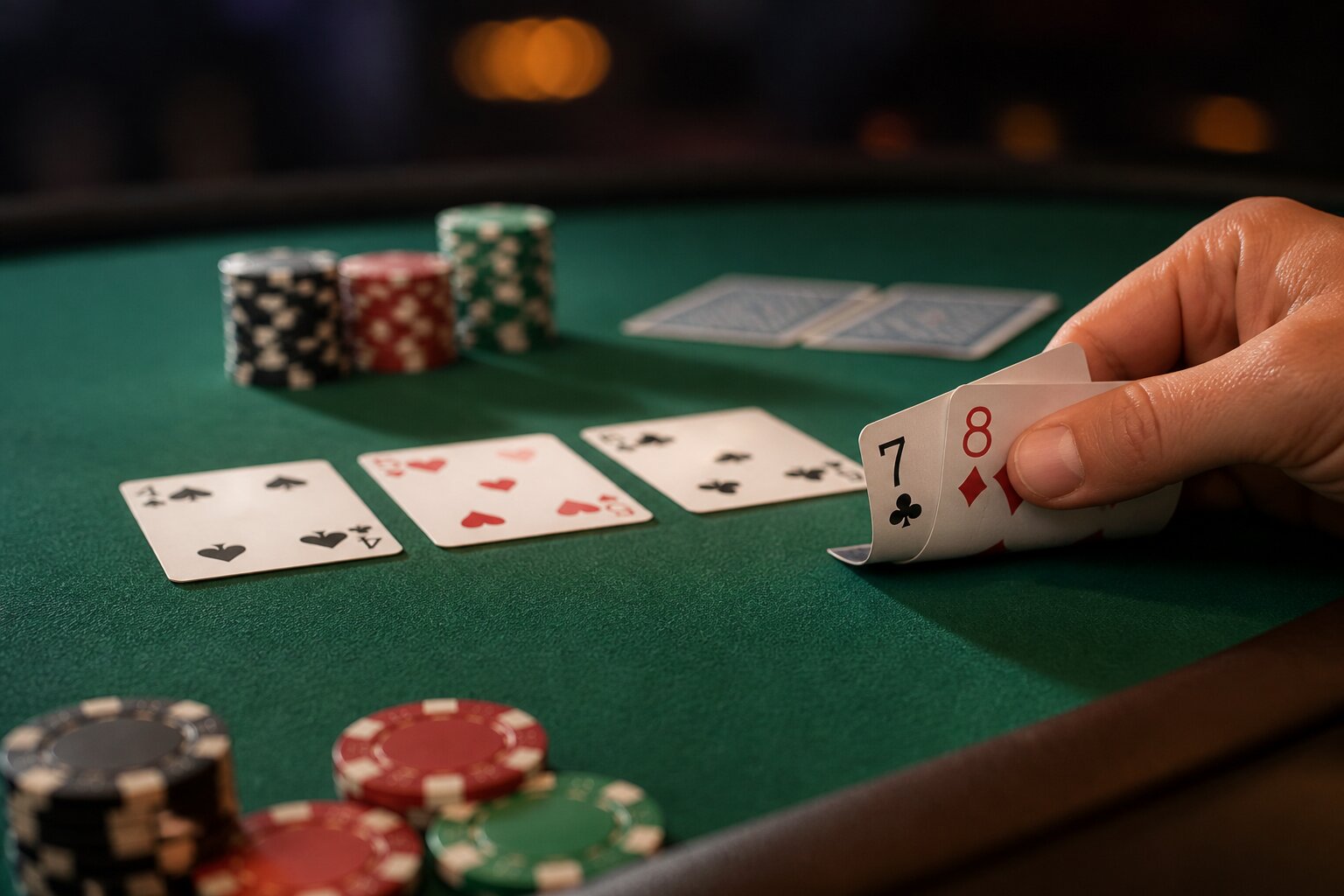
Ever found yourself clinging to a gutshot straight draw, heart pounding, hoping the turn delivers the card you desperately need? You’re not alone — the gutshot is one of poker’s most misunderstood hands, sparking debates in British poker rooms and online forums alike.
There’s something tempting about chasing that perfect card, convinced it’s just around the corner and will change the hand. But before committing chips, it pays to untangle myth from fact and see what a gutshot really offers at the table.
What Is a Gutshot Straight Draw?
A gutshot straight draw, sometimes called an inside straight draw, happens when only one specific rank will complete a straight by filling a gap in a sequence. Unlike an open-ended straight draw, where two different ranks can finish the straight, a gutshot requires a single rank to land.
For example, with 7♥ 8♣ and a flop of 5♠ 6♦ Q♠, only a 9 completes the straight to make 5-6-7-8-9. That single rank gives just four outs in the deck, making the draw substantially less likely than an open-ender.
Spotting a gutshot is straightforward once you know what to look for, but recognising it quickly at a busy table can be harder. Next, we’ll sort through the common myths that lead players astray and explain why the gutshot’s reputation often outstrips its value.
Debunking the Rarest Gutshot Poker Myths
There are plenty of myths floating about when it comes to the gutshot straight draw. Beliefs that sound convincing at first can lead to poor decisions and misplaced confidence, so it helps to separate fact from fiction.
Does Hitting a Gutshot Mean Guaranteed Victory?
Making a straight after hitting a gutshot does not automatically mean the best hand. A completed straight can still be beaten by a higher straight, a flush, or a full house. For instance, a 9 completing 5-6-7-8-9 might still lose if an opponent holds 10-J for a higher straight, or if the board pairs and an opponent holds a full house.
Thinking of a hit as a guaranteed win can encourage reckless play; a better approach is to consider how the completed hand sits against common opposing holdings and the way the board has developed.
Is the Gutshot Draw Only for Beginners?
Gutshot draws are not confined to inexperienced players. Professional and experienced players encounter and sometimes use gutshots strategically. The difference lies in how the draw is incorporated into broader tactics: it can be part of a semi-bluff, a way to apply pressure, or a calculated speculative play when pot odds and position justify it.
The key is not the draw itself but the context — bet sizes, opponent tendencies, and tournament or cash-game dynamics all influence whether a gutshot is worth pursuing.
Are Gutshot Draws Harder to Spot Than Other Straight Draws?
Gutshots can be trickier to spot than open-ended draws because the necessary card sits between the known ranks rather than at the ends. Open-ended draws generally stand out: with a 7♠ 8♠ and a board of 9♣ 10♦ 2♥, either a 6 or a J completes the straight, making the possibilities obvious.
A gutshot such as holding 6♣ 8♦ on a 5♥ 7♠ Q♦ board requires spotting that only a 9 will finish the sequence. Less experienced players, or those distracted by action elsewhere, can miss this possibility. Gutshots are also easier to disguise, because the connecting card is not as visually obvious on the board, so opponents may not realise you have a potential straight until the river.
Skilled players routinely check for all straight combinations to make more informed reads and choices. They also consider factors such as blockers and position, which can influence how likely an opponent is to hold the single missing rank. Recognising these subtleties helps with both calling and folding decisions in later streets.
Odds & Probabilities: How Often Do Gutshot Draws Hit?
Gutshot straight draws are less likely to hit because they offer only four outs. On the flop in Texas Hold’em, there are 47 unseen cards; with four outs, the chance of completing the draw on the turn is about 8.5% (4/47). If the turn misses, the river offers roughly 8.7% (4/46). Using both the turn and river together gives combined odds of around 16.5% to complete the gutshot from flop to river.
To illustrate, with 4♥ 5♥ on a 6♠ 7♦ Q♣ flop, only an 8 will make the straight, and there are only four such cards left in the deck. Knowing these percentages helps decide whether the potential reward justifies the cost of continuing. Having established how unlikely it is to hit, the next section compares gutshots with the more favourable open-ended draw.
Gutshot vs Open-Ended Straight Draws: What’s the Difference?
The distinction comes down to outs and structure. A gutshot requires one rank and provides four outs. An open-ended straight draw can be completed by two different ranks, giving eight outs in total. For example, 6♠ 8♣ on a 5♦ 7♥ Q♦ needs only a 9 (four outs), while 7♠ 8♠ on 9♣ 10♣ 2♦ can be completed by either a 6 or a J (eight outs).
That difference translates directly to playability: an open-ender has roughly 31.5% chance to hit from flop to river, versus about 16.5% for a gutshot. Players generally treat open-ended draws as more valuable because they offer twice the chance to improve, yet gutshots still have strategic use when combined with position, fold equity, or additional hidden outs.
With those contrasts clear, the final question is when, if ever, it makes sense to pursue a gutshot.
Should You Ever Chase a Gutshot Draw in Poker?
Chasing a gutshot means staying in a hand hoping for a single specific card. Whether that choice is sensible depends on pot odds, the cost to continue, table dynamics and the extra value a completed straight might realistically have against likely opponent hands. If the pot offers favourable returns compared to the bet required, and if the turn or river could also give you additional leverage — for example by enabling a bluff or by improving your relative position — then calling or raising can be justified.
Conversely, when the bet is large relative to the pot or when opponents are likely to hold hands that still beat a completed straight, folding is often the prudent option. It’s also important to avoid chasing out of frustration or in pursuit of a comeback; consistent, measured decisions preserve both chips and the long-term enjoyment of the game. Play with an eye on probability, opponent behaviour and your own limits, and you’ll reach better outcomes more often.
This wraps up the main points about gutshot straight draws: what they are, how likely they are to hit, how they compare with other draws, and the situations where pursuing one can make sense. Use these insights to judge gutshot situations more clearly at the table and to take decisions that fit your overall strategy.
Enjoy Casino Games at Freebet Casino
We invite you to join our friendly community and explore the fun of casino games together with us. Discover what makes playing with us an enjoyable experience among friends.
Getting started is easy: just set up your account, make your first deposit and you’re ready to play. We look forward to welcoming you as the newest member of our growing community.
**The information provided in this blog is intended for educational purposes and should not be construed as betting advice or a guarantee of success. Always gamble responsibly.