
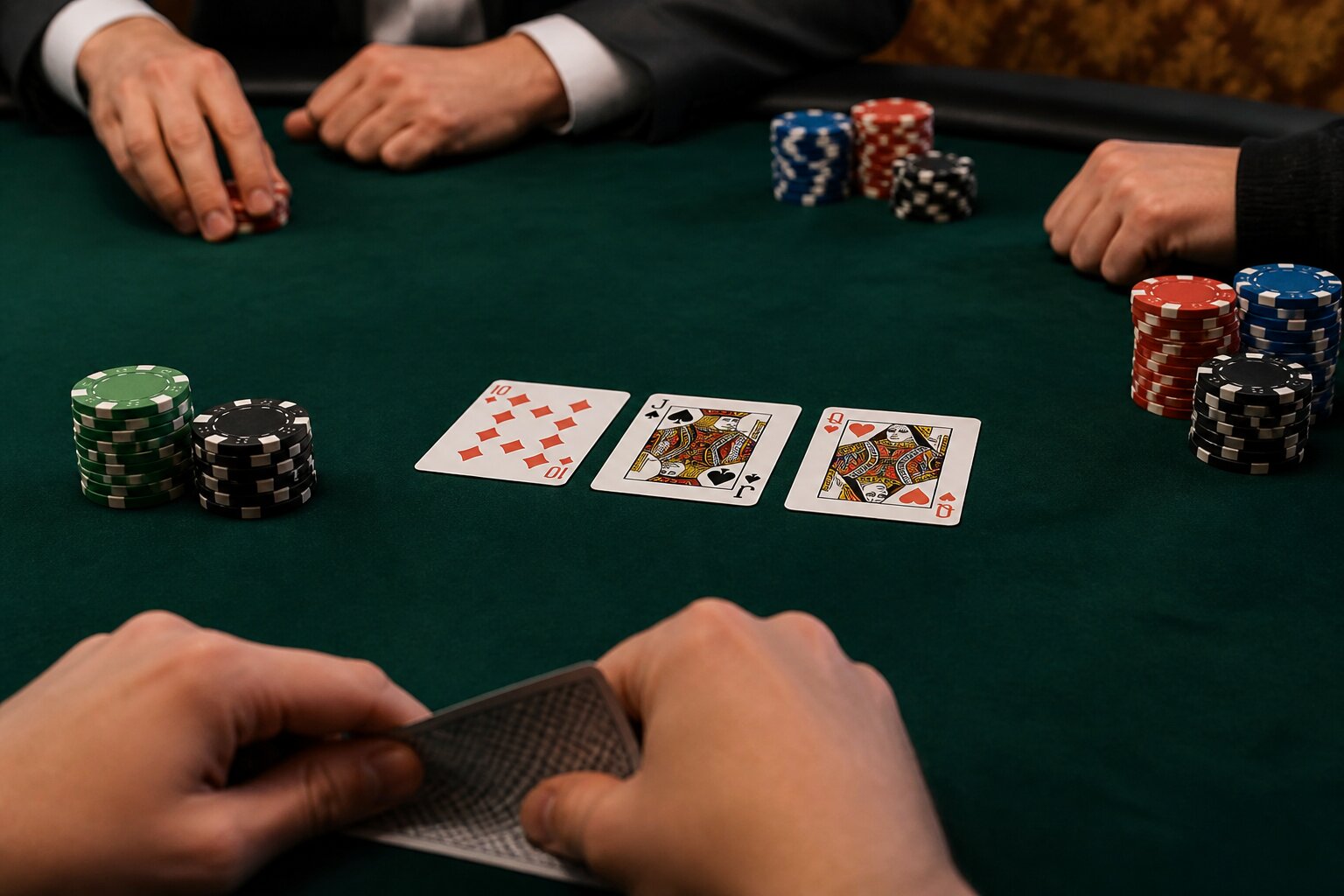
Stepping into the world of poker? The flop is where the game becomes clearer and decisions start to matter in new ways. It’s the moment your two private cards meet three shared cards on the table, and that interaction sets the tone for the rest of the hand.
This guide explains what the flop is, how to read it, and how to think about betting and position so you can make more informed choices. Read on and you’ll find practical insights and examples to sharpen your flop play.
Ready to get to grips with flops and sharpen your poker skills? Let’s take a closer look at what you should be watching for after the first three cards hit the table.
What Is the Flop in Poker?
The flop is a key stage in games like Texas Hold’em and Omaha, coming immediately after the first round of betting. Three community cards are dealt face up in the centre of the table, and every remaining player can use them along with their private hole cards to form the best five-card hand.
That sudden availability of extra cards can change a hand dramatically: a weak starting hand can pair up, while a promising one may suddenly face new threats from the board. Once the flop appears, players have another round of betting to respond to how the board has altered their prospects.
Understanding the flop isn’t just about the cards themselves; it’s also about how those cards interact with your hole cards and what options they create for opponents. That interaction guides choices on whether to stay in, raise, or step away.
How Do Poker Flop Hands Differ from Pre-Flop and Turn Hands?
Each stage of a hand adds new information and alters the range of possible hands. Pre-flop decisions are made with only your two hole cards in mind, so choices tend to hinge on simple combinations and position. The flop introduces three shared cards, which can form pairs, draws or even complete strong hands immediately. The turn then adds a fourth community card, further changing the probabilities and potential outcomes.
Because each street shifts the landscape, your thinking must adapt. Pre-flop you estimate ranges; on the flop you evaluate concrete improvements and potential draws; on the turn you refine that picture further and decide whether to commit more chips. Recognising how your hand evolves helps you make reasoned betting choices rather than reacting blindly.
Common Poker Flop Hand Types Explained
When the flop comes down, several typical hand categories tend to dominate players’ thinking. Knowing them helps you judge both your own position and what others might hold. It also guides decisions about pot control, aggression and when to seek or avoid confrontation.
Top Pair
Top pair occurs when one of your hole cards pairs the highest card on the flop. It is often a hand worth protecting, though its strength depends on the board texture and opponent action. For example, top pair on a dry board (unconnected, mixed suits) is stronger relative to top pair on a coordinated board that offers many draws.
You should consider your kicker, stack sizes and who is still in the hand. A weak kicker or lots of aggressive action behind you can make top pair a hand to play cautiously.
Overpair
An overpair is when your pocket pair ranks higher than any card on the flop, such as pocket Queens on a 9-5-2 flop. Overpairs can dominate single paired hands but are vulnerable if the board becomes connected or introduces overcards.
Position and the number of opponents matter: overpairs play better heads up than against multiple callers, and you should reassess if turn cards bring potential straights or flushes.
Flush Draw
A flush draw happens when you have four cards of the same suit between your hole cards and the flop. It can be an “open” draw with many outs to complete a flush on later streets.
The number of opponents and their betting patterns affect how you treat such a draw in terms of pot odds and implied odds. You should also be mindful of blockers and the possibility of a higher flush for an opponent.
Straight Draw
Straight draws appear when you hold four cards in sequence and need one more to complete a five-card straight. An open-ended straight draw offers two ranks that complete it, while a gutshot draw needs a single specific rank.
The likelihood of completing these draws and the pot size will influence whether you pursue them. Consider fold equity and the cost to continue, and be wary on turn and river cards that bring additional draws for your opponents.
Set or Three of a Kind
A set occurs when you hold a pocket pair and one matching card appears on the flop, producing three of a kind. Sets are powerful but can be vulnerable to straights or flushes on later streets, so the safety of the board texture matters.
When you flop a set, aim to extract value while protecting against coordinated boards; checks and cautious raises may be appropriate depending on how many players remain.
Each of these types carries different strategic considerations. The following factors will shape whether these hands are strong, vulnerable or serve as semi-bluffs in the moment:
- The board’s connectivity and suits.
- The number of active players.
- Opponents’ betting behaviour and tendencies.
- Stack sizes, position and the size of the pot.
How to Read the Board After the Flop?
Reading the board means looking beyond just whether you’ve improved and considering the full range of hands the flop enables. Start by identifying obvious threats—paired boards, two-suit flops that create flush possibilities, or sequences that allow straights. Then compare those possibilities with what your hole cards offer.
Think about which hands beat you and which hands you beat. For example, a paired board might make full houses possible later, while a two-tone flop may give someone a flush draw. Pay attention to how connected the cards are; closely ranked flop cards often mean straight draws are possible, which affects your decision-making.
Also weigh how many opponents remain active: a draw that feels manageable heads-up might become dangerous in a multi-way pot. Combining these observations with your position and stack sizes will give a clearer picture of the strategic choices ahead.
Take this in as you move into the betting round and consider how others’ actions fit the board’s story.
What Are Typical Flop Betting Options?
On the flop, your options shape the action and communicate information to your opponents. Players commonly choose to check, bet, call, raise or fold, and the choice depends on hand strength, pot size, position and the board’s nature.
Checking passes the action without adding chips; it can be used to control the pot or mask the strength of a hand. Betting builds the pot and can protect a vulnerable hand or extract value from weaker holdings. Calling keeps you in without escalating the pot, useful when you have a draw or a hand you prefer to see the next card with. Raising applies pressure and can force folds or gain value from worse hands. Folding withdraws from the hand when the odds are unfavourable.
Selecting among these options is less about a fixed rule and more about interpreting the situation: what the board suggests, how opponents have acted, and what you expect from later streets. Use pot size, the number of players and your own comfort with risk to guide the choice.
When Should You Bet, Check or Fold After the Flop?
Betting tends to make sense when your hand has improved or when you want to protect a hand against draws. Checking is reasonable when you prefer to keep the pot smaller, gather information or induce a bluff. Folding is the right move if the board and opponent actions suggest you are behind and the cost to continue is not justified.
Consider the relationship between the pot size and the number of outs you have—the potential reward must justify the cost of calling or raising. Also reflect on opponent tendencies: some players bet aggressively with marginal hands, while others only commit with solid holdings. These behavioural cues, combined with the board texture, will help guide the decision.
How Do Position and Opponent Behaviour Affect Flop Betting?
Position gives you a practical edge because acting later allows you to see opponents’ choices before deciding. When you act after others, you can base your action on their bets or checks, which reveals information about their likely holdings.
Opponent behaviour also shapes your approach. A player who rarely bluffs and suddenly bets heavily is more likely to hold a strong hand; conversely, a frequent bluffer’s aggression may carry less weight. Still, experienced players sometimes vary their style to remain unpredictable, so you should weigh patterns over several hands rather than reacting to a single action.
Combine positional awareness with read patterns and the board’s story to choose whether to slow-play, apply pressure or fold. Keeping emotions in check helps ensure those judgements are clear-headed and strategic.
Popular Myths About the Flop: What Should You Ignore?
Poker has its share of myths that can mislead even competent players. One widespread misunderstanding is the idea that past hands influence future deals; in reality, each deal is independent and should be treated on its own merits. Another is assuming that a draw on the flop guarantees a strong finish—many draws fail to materialise, and pursuing them without proper odds can be costly.
People also misinterpret aggression: a big bet doesn’t always signal the nuts, and small bets can conceal strength. Rather than accepting shorthand rules, focus on the underlying mechanics—board texture, pot odds, position and observed tendencies. These give a clearer framework for decision-making than repeating common but flawed sayings.
If you keep a critical mindset and test claims against actual outcomes, you’ll avoid the traps those myths create and make smarter choices at the table.
Tips for Managing Your Bankroll on the Flop
Sound bankroll management is a foundation for playing longer and learning more. Before you sit down, decide the total you are comfortable risking and set limits for individual sessions or hands that reflect that amount. This helps prevent emotionally driven decisions after an unfavourable flop or a bad stretch.
Avoid increasing stakes impulsively to recover losses; that approach tends to magnify losses rather than solve them. Instead, step back, reassess your strategy and return when you can play within your limits. Treat poker as entertainment and budget it accordingly, so fluctuations in results don’t threaten essential finances.
Keeping records of your play and periodically reviewing them helps you see whether your betting choices, especially on flops, align with your bankroll rules and long-term goals.
How Can You Improve Your Poker Flop Play?
Improvement comes from deliberate observation and practice. Reviewing past hands helps you spot patterns in your flop decisions and identify common errors. Watching skilled players—through hand histories or commentary—can reveal how they interpret boards and size bets to control pots.
Testing ideas in low-stakes or free games provides real experience without risking much capital, and reflecting on outcomes after sessions allows you to adjust tactics gradually. Reading strategy material and engaging with thoughtful discussion can broaden your understanding of concepts such as pot odds, implied odds and range evaluation.
Above all, steady, measured practice and honest self-review lead to progress. Keep learning, stay disciplined with your bankroll, and your flop play will become more consistent and effective.
Final thoughts: the flop is where information and opportunity converge. Learn to read the board, judge opponents and manage your resources, and you’ll make better calls and bets as the hand unfolds.
**The information provided in this blog is intended for educational purposes and should not be construed as betting advice or a guarantee of success. Always gamble responsibly.