Ever sat at a blackjack table and wondered if those little coloured cards people whip out actually make a difference? Maybe you’ve heard whispers that strategy cards are some sort of secret weapon, or that you’re not allowed to use them in a “proper” casino. There’s a fair bit of mystery around these cards, and many people have strong opinions about whether they guarantee a win or will get you shown the door.
It’s easy to get caught up in the myths and second-hand stories. Some say casinos dislike them; others claim it’s the only way to stand a chance at the tables. With house rules, etiquette and those circulating rumours, knowing what’s actually allowed – and whether a strategy card helps – isn’t always straightforward.
So, what’s fact and what’s fiction? Let’s get under the surface of the blackjack table and see what’s really going on with strategy cards in British casinos.
What Are Blackjack Strategy Cards?
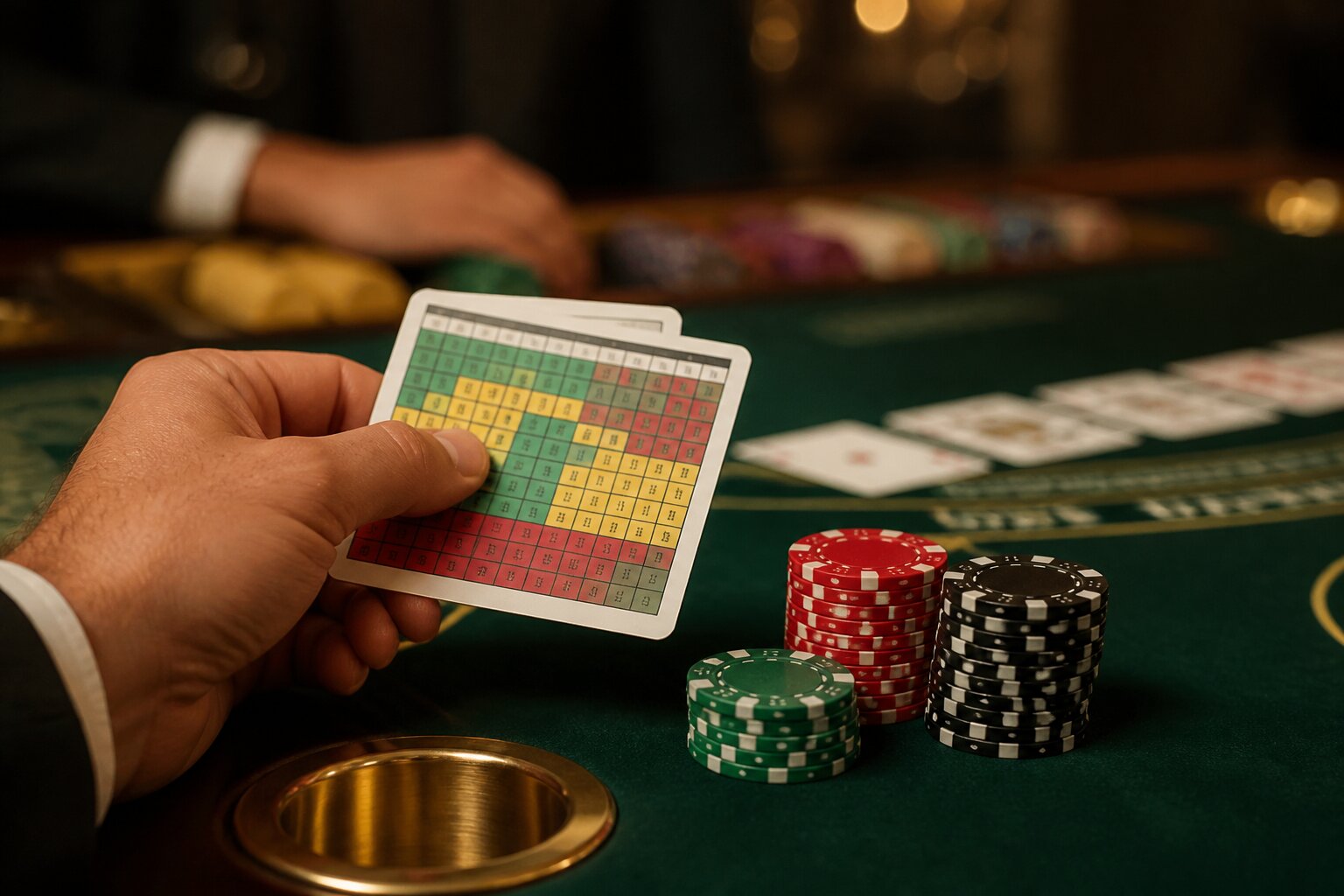
A blackjack strategy card is a compact chart that shows the recommended decision for every common player hand against each dealer upcard. It encapsulates “basic strategy,” a set of mathematically derived plays that, when followed, reduce the house edge compared with casual guesswork.
The card is usually laminated and pocket-sized so it can be consulted quickly at the table. You compare your hand and the dealer’s visible card on the grid and the chart tells you whether to hit, stand, double down or split. For instance, a hard 16 versus a dealer 6 will typically advise standing, while a pair of 8s versus a dealer 9 will advise splitting. Separate sections handle soft hands (those including an ace), which alter how doubling or standing works.
Because basic strategy depends on the precise game rules and number of decks, cards are tailored for particular variants. A card made for a game that allows doubling after splitting on any two cards will show slightly different choices than one designed for a game that restricts doubling. The card doesn’t promise wins, but it is the most reliable way to play each hand according to the underlying probabilities.
If you want to see how closely this theoretical guidance holds up in practice, the next section explains the accuracy of these charts in real casino play.
How Accurate Are Strategy Cards in Real Casino Play?
Strategy cards are built from extensive analysis and computer simulations that calculate the mathematically optimal play for each hand and dealer upcard combination. When the correct chart is used for a given set of rules, basic strategy lowers the house edge substantially. In many standard blackjack games, following basic strategy can reduce the house edge to around 0.5%, compared with roughly 2% or more for instinct-driven play.
Put another way, over very large numbers of hands the expected loss per £100 wagered is far lower when decisions align with basic strategy than when they do not. That improvement becomes meaningful for frequent players or those who play longer sessions.
That said, a strategy card does not change the underlying distribution of outcomes in the short term. There will be stretches of unfavourable results and stretches of favourable results, and a card cannot alter those swings. Its value is in reducing mistakes and aligning choices with what is statistically best given the rules in use. Because rules vary between tables – for example, limits on doubling, different payout rates for blackjack, or varying number of decks – the effectiveness of a particular card depends on selecting the version that matches the game you are actually playing.
With that in mind, the next section covers whether casinos allow these cards and how different venues treat them.
Rules & Variations: Does Every Casino Allow Strategy Cards?
Using a blackjack strategy card at a land-based casino in the UK is generally permitted. There is no regulatory prohibition against consulting such cards at the table, and many venues accept their use so long as it does not interfere with the game or breach an individual casino’s rules.
Casinos set their own table conduct policies within regulatory boundaries, so behaviour that is acceptable at one establishment might be discouraged at another. Some venues sell or distribute basic strategy charts, while others prefer players to keep personal items off the felt. A common compromise is to allow a player to consult a card discreetly, provided it does not slow play or look like written notes being shared among players.
Can You Use Strategy Cards at the Table?
Typically, players can refer to a strategy card while sitting at a table, as long as they are courteous and do not disrupt the dealer or other participants. It is sensible to check for any posted table rules or to ask a member of staff before sitting down; this avoids misunderstandings and keeps the game moving.
Dealers may request that the card be kept out of the way or in the player’s lap rather than laid across the table surface. These requests are practical rather than punitive, intended to preserve the flow of the game and the comfort of other players.
Do Card Rules Differ Between Casinos?
Yes. Individual casinos vary both in how strictly they regulate items on or near the table, and in the precise blackjack rules they use. Differences such as the number of decks, whether doubling after splitting is allowed, and the payout for a natural blackjack affect the optimal strategy. A strategy card designed for one rule set might not be ideal for another, so picking the correct card for the game at hand matters.
Play within the stated table rules, respect staff requests, and be mindful of other players’ enjoyment; the rest is a matter of choosing the right chart for the rules in play. With that clarified, it helps to debunk some common myths that circulate about these cards.
Common Myths About Blackjack Strategy Cards
There are plenty of rumours about strategy cards that cause confusion or unnecessary embarrassment at the table. Addressing them helps clear the air and lets players focus on making sound decisions.
Is Using a Strategy Card Considered Cheating?
No. Using a basic strategy card is not cheating in reputable casinos. These charts are public tools derived from widely available mathematical analysis and are not associated with illicit activities such as collusion or covert advantage play. Casinos generally view them as aids that reduce simple errors rather than as unfair advantages. The key is to use them discreetly and within the house rules so the game remains smooth for everyone.
Do Strategy Cards Guarantee Winnings?
A strategy card provides the statistically best move for each hand given the game's rules, but it does not guarantee a profit. Outcomes at individual hands and short sessions can vary widely; the card reduces the long-term expected disadvantage compared with poor decision-making, but it cannot change the inherent variability of results. Treating play as entertainment and choosing stakes that suit personal finances keeps the experience sustainable.
Having cleared up misconceptions, the next section explains how to read and use these cards in practical terms so they become a natural part of play.
How to Read and Use a Blackjack Strategy Card Effectively
The layout of a strategy card is straightforward: dealer upcards typically run across the top, while your possible hand totals are listed down the side. The intersecting cell contains the recommended action, often abbreviated: H for hit, S for stand, D for double, and P for split. Soft totals and pairs typically have dedicated sections to reflect the different strategic choices they present.
During play, identify your hand category (hard total, soft total or pair), find the appropriate row and column, and make the indicated move. For example, a pair of 8s versus a dealer 10 will usually show P for split; a hard 16 against a dealer 10 will usually show H for hit. Colour coding on some cards speeds recognition when glancing between decisions.
Be quick and unobtrusive when consulting the card — keep it in your lap or on your person and reference it between rounds rather than interrupting the action. Familiarity with the chart reduces hesitation and helps maintain the table’s rhythm. Mastering this simple habit makes it easier to follow the maths without slowing down the game, and it naturally leads into considering the benefits and drawbacks of relying on a card.
Pros & Cons of Relying on Strategy Cards
There are clear advantages to using a strategy card. It eliminates guesswork, helps avoid common errors, and aligns play with the mathematically sound choices for the rules in play. For newcomers, the card builds confidence and reduces hesitation; for more experienced players, it serves as a quick reminder in unusual situations. Over large numbers of hands, decisions made according to basic strategy reduce expected losses compared with ad hoc play.
On the flip side, frequent consultation can slow the pace and alter the social feel of a table where many players act from memory. Some players find that leaning too heavily on a card removes spontaneity, making the session feel more mechanical. There is also the practical point that a mismatch between the card’s assumptions and the table’s rules will reduce its effectiveness, so selecting the correct chart is important.
Used thoughtfully, a strategy card is a useful tool rather than a crutch; it helps players make consistently sound choices while still enjoying the live-table experience.
Final thoughts on using strategy cards tie these points together and leave you ready to act with confidence at the table.
Explore Casino Games at Freebet Casino
At Freebet Casino, we take pride in offering a wide variety of casino games for everyone to enjoy. Whether you are seeking something familiar or looking to discover something different, our site is here for your entertainment.
Getting started could not be simpler: just create an account, make a deposit and choose what suits your style. We would love for you to join us and see what you enjoy most.
**The information provided in this blog is intended for educational purposes and should not be construed as betting advice or a guarantee of success. Always gamble responsibly.