
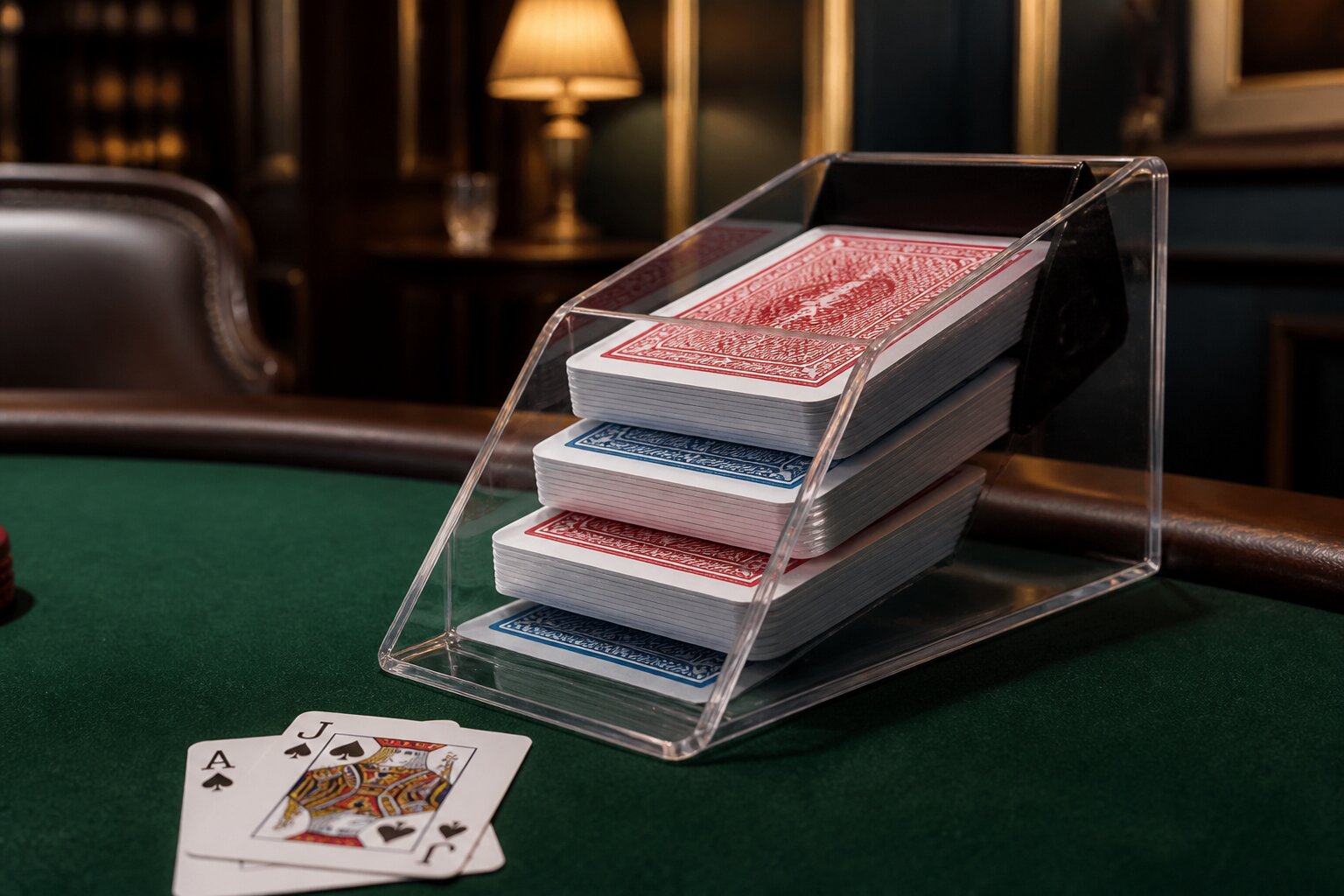
Ever wondered what that box on the dealer’s table is or why it matters in your game of blackjack? You’re not alone—many players are curious about the blackjack shoe and the number of decks it holds.
Understanding the basics can make a real difference to how you play and what to expect at the table. The number of decks affects the odds, the pace of play and sometimes the strategy choices available to you.
If you’ve ever asked why some games feel different or whether fewer or more decks matter, keep reading to learn what a blackjack shoe does, why casinos use them and how deck count influences play.
What Is a Blackjack Shoe?
A blackjack shoe is a simple dealing device that sits at the dealer’s side and holds multiple decks of cards. It keeps the decks in order so the dealer can draw cards one at a time without handling single packs, which makes dealing smoother and keeps the pace of the game steady.
Using a shoe has a few practical benefits for play:
- It speeds up the game by allowing continuous dealing.
- It reduces the need to reshuffle frequently.
- It limits opportunities for tampering or accidental dealer errors.
Shoes are commonly used with several decks at once — typically four, six or eight decks — and a cut card is often placed toward the back to mark where dealing will finish. In live games you will see a physical shoe; online versions mimic the same arrangement in software, dealing virtual cards as though from a real shoe. This consistent method of dealing helps provide a fair and predictable experience for everyone at the table.
Why Are Multiple Decks Used in Blackjack?
Casinos use multiple decks mainly to keep games flowing and to make certain advantage techniques harder to apply. Using a larger shoe means dealers do not have to stop and reshuffle as often, so players see more hands per hour and the pace at the table stays steady. That steady pace is useful for busy tables and for managing staffing and floor schedules.
Multiple decks also change the information available to players who try to track which cards have been dealt. When there are more cards in play, the impact of any single card is diluted, which makes common card-counting systems much less practical and reliable. The result is that it becomes harder for a player to gain a consistent edge over the house.
Beyond security and efficiency, different deck sizes let casinos offer a wider range of game types to suit various preferences. Variations in deck number can affect:
- how long a shoe lasts before reshuffle,
- how much variance players experience from one hand to the next,
- small differences in house edge and strategy decisions.
Casinos may also combine multiple decks with devices such as continuous shuffling machines or specific cut-card positions, further influencing game speed and card predictability. These tools and choices help operators balance fairness, entertainment value and the practical needs of running a busy gaming floor.
How Many Decks Are Common in a Blackjack Shoe?
Most tables use between four and eight decks in a shoe. Six and eight decks are particularly common in larger venues and for many live dealer formats. Single- and double-deck games appear less frequently, especially in busy casinos.
Online providers often mirror these options. You will commonly find:
- four-deck games,
- six-deck games,
- eight-deck games,
with occasional single- or double-deck variants for players who prefer a different experience.
Deck size can have a modest effect on how the game plays, influencing factors such as house edge and the effectiveness of some strategies. If deck size matters to you, check the game details before you sit down or join a table.
Does the Number of Decks Affect the Game?
Deck count does influence probabilities and therefore the relative house edge. Fewer decks slightly change the likelihood of certain card combinations, which can affect the mathematical advantage for the player or the house. In practice, these differences are generally modest, but they can be meaningful for players focused on small percentage edges.
Casinos may also adjust specific rules depending on the number of decks—things like when doubling down or splitting is allowed—so similar deck counts can still produce different overall playing conditions. Rather than promising any outcome, deck size is one factor among many that determine how a session will feel and perform.
Is There a Standard Shoe Size in British Casinos?
In British land-based casinos the most common shoe sizes are six and eight decks; this standard helps maintain consistency across tables and venues. Smaller deck games, such as three or four decks, occasionally appear but are less typical, and single- and double-deck tables are rare on the main casino floor.
Live dealer games streamed online generally follow the same conventions as physical tables, so you’ll usually see the familiar six- or eight-deck arrangements there too. If you’re unsure about a particular table, the dealer or game information will confirm the deck count.
How Does This Compare to Online Blackjack?
Online blackjack offers a bit more variety in deck sizes and rule sets. Many digital tables match the six- or eight-deck format for familiarity, while some tailored online games use one or two decks to create a distinct play style. Live-streamed dealer games typically stick to the same deck sizes used in physical casinos to keep the experience authentic.
Are There Any Myths About Decks in a Blackjack Shoe?
There are a few persistent misconceptions about how the number of decks affects play. These can lead players to overestimate what deck count alone can achieve.
-
Many players believe that simply knowing the number of decks gives a guaranteed advantage. While the number of decks does change the mathematical probabilities for certain outcomes, it does not remove the inherent uncertainty of the game and cannot assure specific results. Skillful decisions and an understanding of probabilities can improve expected outcomes, but they do not guarantee winning on any given hand.
-
Some think that particular deck sizes are manipulated to favour the house or the player. In reality, licensed operators must follow strict regulations and procedures to keep games fair. Independent audits, regulatory oversight and standardised dealing practices are used to safeguard game integrity and detect irregularities.
Understanding what deck count changes and what it does not helps separate sensible expectations from unfounded beliefs. Deck count can influence basic strategy nuances and some advanced techniques, yet it is only one factor among many, including rules variations, dealer practices and player behaviour. Staying informed, playing within your means and treating wins and losses as probabilistic outcomes are the most sensible approaches.
How to Spot the Number of Decks in Use at a Casino
Finding out how many decks are in play is straightforward. In land-based venues the table rules usually display the deck count; if not, dealers can confirm it. Shoe-fed games will commonly use multiple decks, while single-deck tables are often hand-dealt and clearly marked.
Online games list this information in the game details or help section, and live-stream interfaces often show the deck number on screen. In some live and online setups a continuous shuffler or virtual reshuffle will be used, which effectively resets the deck composition between hands.
Useful places to check for the deck count include:
- Table signage and rule cards in the casino.
- Asking the dealer or floor staff.
- Game information, help pages or lobby details in online casinos.
- On-screen indicators in live-streamed tables.
Knowing the deck count before you join a table helps you choose a game that suits your preferences and prepares you for the specific rules that may apply. It can also affect:
- The basic house edge and payout expectations.
- The effectiveness of certain strategies and moves.
- How quickly cards are reshuffled and how that impacts betting decisions.
If you are unsure, ask casino staff or consult the game provider’s support. Always play responsibly and be aware that rules and deck configurations can vary between venues and providers.
Conclusion: Understanding Decks in a Blackjack Shoe
Knowing the number of decks in a blackjack shoe helps you understand how a particular table will play: it affects dealing pace, odds and the practicality of certain strategies. While deck size can change the mathematics of the game, it does not guarantee outcomes or favour specific players.
Check the table rules or game information so you know what to expect, and choose the version of blackjack that fits your approach. Please remember you must be 18 or over to play, and if you have concerns about gambling there are support services available. Whether you prefer fewer decks or more, the best choice is the game that matches how you like to play.
**The information provided in this blog is intended for educational purposes and should not be construed as betting advice or a guarantee of success. Always gamble responsibly.