
Ever watched a film where the sharpest mind in the casino seems to have an almost magical knack for always beating the dealer? It’s tempting to imagine a secret formula that turns the odds in your favour at blackjack. For decades, card counting has sparked curiosity—and plenty of myths—among players keen to sharpen their play.
But grabbing a deck and trying to keep track of every Ace and 10 is much tougher in a real casino than it looks on screen. That’s why many players use card counting simulators to practise before they ever sit at a live table.
What really makes practice effective, and which tools move someone from casual interest to genuine skill? The next section lays out what a simulator does and what to expect when you begin training.
What Is a Card Counting Simulator?
A card counting simulator is a digital practice tool that recreates the flow of a blackjack game so users can work on counting, bet variation and strategic choices without staking money. Simulators focus on the mental tasks involved in card counting—keeping a running or true count, adjusting for the number of decks, and recognising the moments when bet size or strategy should change.
Simulators appear as apps, browser tools or practice modes within gaming platforms. The best ones let you choose deck numbers, switch counting systems, adjust deal speed and receive feedback on accuracy and response time. They are used by adults who want to study the maths and memory work behind blackjack in a controlled environment, and they provide a risk-free way to build skill and confidence.
The next section describes the practical tools players combine with simulators to make practice efficient and realistic.
Essential Tools for Practising Card Counting
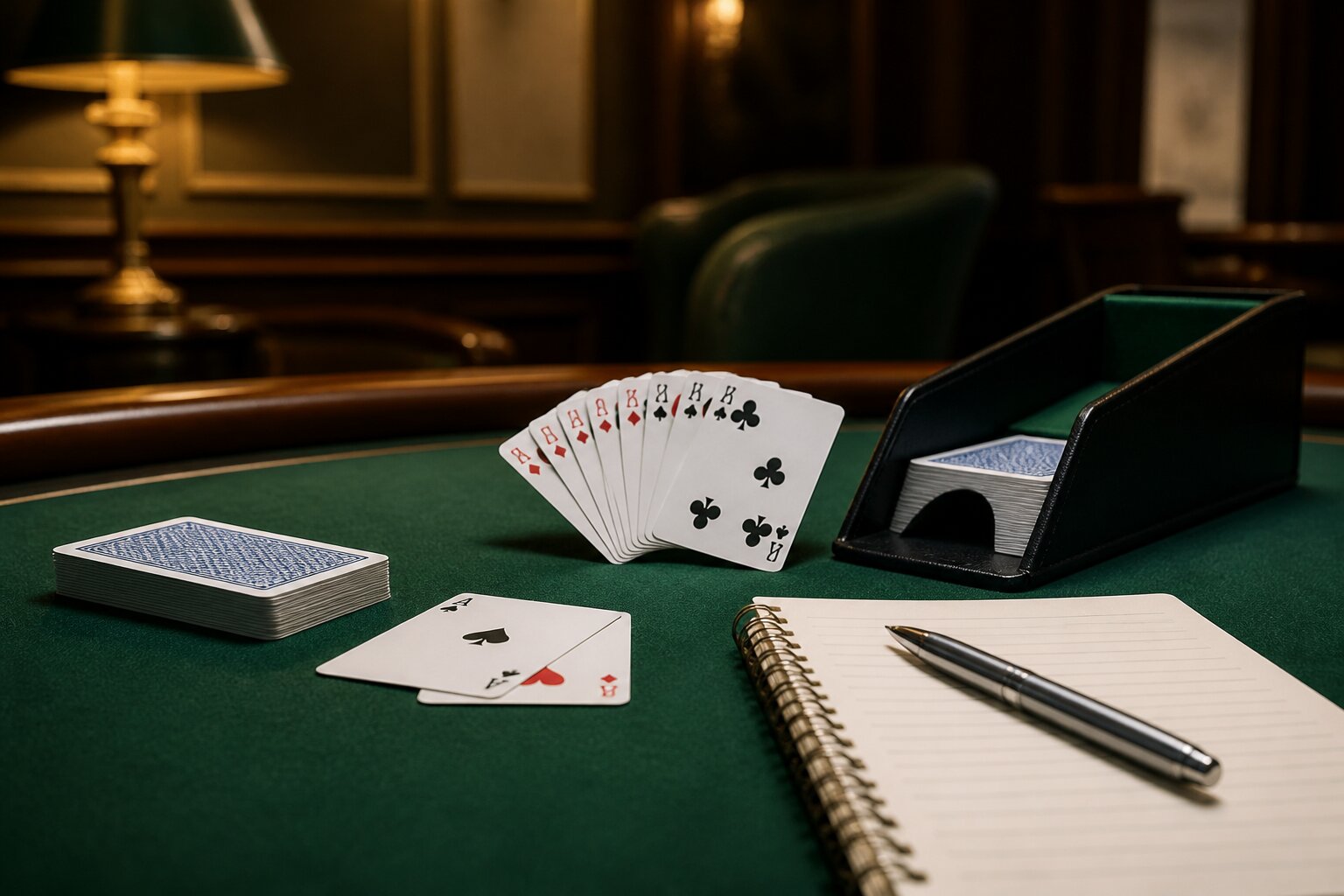
Getting started doesn’t require expensive kit, but a few key items make practice more productive. A single 52-card deck is the simplest and most direct training device; handling real cards helps build speed under conditions similar to live play.
Digital tools complement physical practice. Quality simulators and trainer apps handle dealing, timing and performance tracking so you can concentrate on your count. Strategy charts are useful references to ensure basic play decisions remain correct while you focus on counting. Simple score-tracking—pen-and-paper logs or a spreadsheet—lets you spot trends and measure improvement over time.
Regularly using a mix of physical cards and digital drills helps develop accuracy, speed and mental endurance without any need to risk money. With that foundation, it’s useful to understand the counting systems you’ll be practising, detailed next.
Popular Card Counting Systems Explained
Several systems are commonly taught because they balance simplicity and effectiveness in different ways. Each assigns point values to cards so the counter can maintain a running total and estimate when the deck favours larger wagers. These methods are tools for understanding relative changes in deck composition rather than guarantees of success, and real-world conditions such as casino countermeasures, shuffle procedures and table rules can significantly affect their usefulness.
Hi-Lo System
The Hi-Lo system is a balanced method that’s relatively straightforward to learn. Cards are valued as follows:
2 to 6 = +1
7 to 9 = 0
10, Jack, Queen, King, Ace = -1
As cards are played, players update a running total. A higher positive total indicates a proportionally greater concentration of high-value cards remaining in the shoe, which affects betting and play decisions. Because it is balanced, the count will return to zero over a full deck; this feature makes it simpler to translate into a true count when multiple decks are in use, but it also requires the counter to estimate decks remaining to adjust bets accurately.
While Hi-Lo is effective for many recreational counters, it requires practice to maintain accuracy during fast play and to avoid drawing attention from casino staff. It is not a guaranteed way to win and should be approached with awareness of rules and potential consequences at licensed venues.
KO (Knock-Out) System
KO is an unbalanced system that simplifies counting by avoiding a final zero that requires deck adjustment. Values are:
2 to 7 = +1
8, 9 = 0
10, Jack, Queen, King, Ace = -1
Because the count does not need to be converted based on decks remaining, KO can be easier for some learners to translate into betting choices. The unbalanced nature means the running count will drift away from zero as cards are removed, which some players find more intuitive when playing with multiple decks.
That said, KO still demands concentration and practice to apply effectively, and it may not offer the same level of theoretical precision as balanced systems when exact deck composition matters. Casinos may also respond to obvious patterns of variable wagering, so counters should be cautious and familiar with local rules and enforcement practices.
Omega II System
Omega II introduces multiple weightings for greater theoretical accuracy, but it demands more concentration. Values are:
2, 3, 7 = +1
4, 5, 6 = +2
8, Ace = 0
9 = -1
10, Jack, Queen, King = -2
This system can offer finer-grained information about the shoe composition but is harder to maintain under pressure. The varied weights intend to improve the precision of the count, which can be useful in simulations or controlled practice, but they also increase the mental load during live play.
Players considering Omega II should weigh the potential gains in accuracy against the higher risk of mistakes and the additional time needed to become proficient. As with other methods, success is not assured and real-world factors like shuffling frequency and casino policies will influence any practical advantage.
Next, we’ll look at how simulators bring these systems to life and test the skills they teach.
How Do Card Counting Simulators Work?
Simulators recreate a blackjack shoe and prompt the user to apply their chosen counting system as cards are dealt. At the start, typical settings include number of decks, counting method and deal speed so the environment can mirror many real-game conditions.
During a session, cards appear in sequence and the user updates their running count. Some training modes require manual input of the count at set intervals, while others keep track secretly and test you at the shoe’s end. Many simulators also ask for the true count—the running count divided by estimated decks remaining—to help calibrate betting decisions as the shoe progresses.
An example: in a Hi‑Lo mode with four decks, cards appear in this order—5, King, 3, 9, Ace, 2. Applying Hi‑Lo values produces a running total that the simulator can check against the user’s input, providing immediate feedback on accuracy. Post-session reports typically show accuracy percentage, average response time and error patterns so practice can target weak points.
Understanding how simulators deliver feedback helps explain why regular practice leads to measurable improvements, which is explored in the following section.
Benefits of Using a Card Counting Simulator
Simulators compress the repetitive volume of hands needed to build fluency, letting users practice many more deals in a short time than would be possible at a live table. That repetition builds speed in mental arithmetic and strengthens memory for tracking card values under time pressure.
They also highlight common errors. Detailed session statistics reveal when counts start to slip—perhaps during faster deals or after a few hands—so learners can adjust their focus. Simulators allow experimentation with different deck sizes and rule sets, showing how those variables influence counting effectiveness.
Beyond technical gains, the main payoff is improved decision-making: knowing when the count suggests changing standard play or bet size. These tools are for developing skill and understanding, and when used sensibly they fit into a wider approach to controlled, informed practice.
With those advantages in mind, the next section explains how to choose a simulator that suits individual needs and learning styles.
Choosing the Right Card Counting Simulator
Selecting a simulator comes down to matching features to learning goals and ensuring the tool is reliable. Look for realistic deck options (single, double and multi-deck), adjustable deal speed to build up pace safely, and modes that test both running and true counts. Error-tracking and post-session analytics are especially valuable for guided improvement.
Good simulators let you switch between counting systems, and include scenarios that reflect common rule variations so practice feels relevant. Ease of use matters too: clear interfaces and the ability to pause or slow the deal reduce frustration while learning.
Keep practice sessions structured: set time limits and a clear objective for each session—speed, accuracy, or converting running counts to true counts. Use the session feedback to focus future practice, aiming for steady improvement rather than immediate perfection.
Now that you know what to look for, the following section dispels common myths that can mislead learners about what practice will achieve.
Common Myths About Card Counting Practice
Misinformation can create unrealistic expectations about what counting practice delivers. Here are some common myths and the realities you should keep in mind.
Myth: Anyone can win easily by counting cards.
Fact: Counting can reduce the house edge in specific conditions, but it does not guarantee wins. Casino games retain an element of variance and outcomes can fluctuate.
Myth: Using a simulator makes you unbeatable at blackjack.
Fact: Simulators improve memory and arithmetic, but they cannot fully reproduce real-world distractions or social pressures at a live table; performance may differ outside the training environment.
Myth: Card counting is illegal in the UK.
Fact: The practice of card counting itself is not a criminal offence, though using devices or breaking specific venue rules can be prohibited; establishments may refuse service if they choose.
Myth: Anyone can master card counting quickly.
Fact: Effective counting requires sustained practice and mental discipline; most people need considerable repetition to reach a reliable level of accuracy under time pressure.
Myth: Card counting guarantees profits over time.
Fact: Even skilled players face extended periods without positive returns due to natural outcome variation; practice develops skill but does not remove uncertainty.
Clearing up these misconceptions helps set realistic goals for training and keeps expectations grounded as practice continues. Finish by applying what you’ve learned: choose a simulator that fits your goals, practise with focused sessions, and use feedback to build steady progress.
Play Online Casino Games at Freebet Casino
We welcome you to enjoy a wide choice of casino games with us, designed for entertainment and enjoyment at your own pace. Take your time exploring our site and see what you like.
Getting started is as simple as creating an account, making a deposit and choosing what to play. We look forward to having you with us.
**The information provided in this blog is intended for educational purposes and should not be construed as betting advice or a guarantee of success. Always gamble responsibly.