
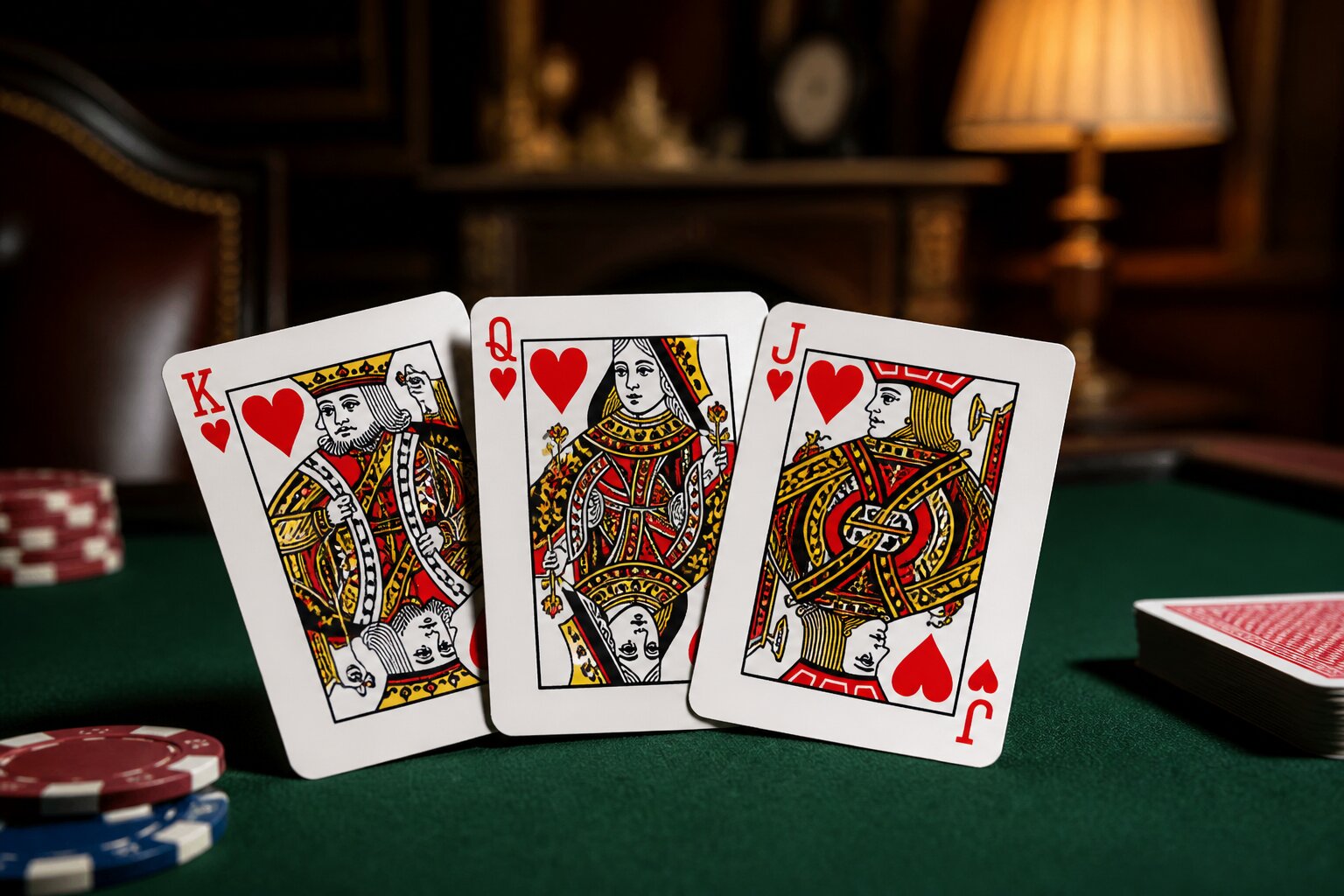
Have you ever picked up a deck of cards and noticed some show people rather than numbers? Those are face cards, and they stand out because of their artwork and the roles they play in many games.
Face cards carry a lot of history in their designs and a practical function in gameplay. Read on to learn what they are, how they’re used, and how different traditions around the world portray them.
What Is the Definition of a Face Card?
A face card is any playing card that features the image of a person. In a standard 52-card deck this means the King, Queen and Jack in each of the four suits: hearts, diamonds, clubs and spades.
These cards are often called court cards as well, because their figures traditionally represent members of a royal household. Altogether a typical deck contains 12 face cards: three in each suit. While designs vary from deck to deck, the essential idea remains the same — a face card is identified by its human portrait rather than by a numeric pip.
If you need a quick mental shorthand: whenever a card shows a person, you’re looking at a face card.
Which Cards Count as Face Cards?
In a standard 52-card deck, the face cards are the Jack, Queen and King of each suit. These are sometimes called court cards or picture cards because they typically show a portrait of a person rather than just a number.
Note that the suits are the organising groups that contain those three court figures:
- Hearts
- Diamonds
- Clubs
- Spades
Each suit contains one Jack, one Queen and one King. That makes twelve face cards in total across the deck.
Face cards sit alongside the number cards and the aces. Their role or point value changes depending on the rules of the game being played, so some games may treat them all the same while others give each a distinct value or effect.
What Does Each Face Card Represent?
Historically, the imagery on face cards reflects roles and personalities drawn from court life.
Kings are typically shown as rulers, often holding a scepter, sword or orb — visual shorthand for authority. Queens are depicted as noble women, sometimes carrying flowers or other symbols of dignity. Jacks (once called knaves) are generally younger male figures, attendants or soldiers serving the court.
These images aren’t just decoration: they evolved from regional art and social structures, and they give each card a recognisable character. That said, the visual symbolism doesn’t change how cards function in rules-based games; the meanings are cultural and artistic rather than rule-based.
Why Are They Called Face Cards?
The phrase “face card” comes simply from the fact these cards show human faces. The illustrated portraits stand out against the numbered cards, so the descriptive name became common as playing cards spread across Europe and beyond. Over time the term stuck because it was an easy way to distinguish pictorial cards from pip cards.
The alternative term “court cards” hints at their original intent: to represent figures found in royal courts. Historically these included kings, queens and knaves or jacks, and the imagery often reflected the fashions and hierarchies of the era in which the deck was produced.
Which name you use often depends on local tradition and language. Some places use “picture cards” or other regional terms, but all of these names point to the same group of cards: those bearing portraits of people.
How Are Face Cards Used in Card Games?
Face cards often carry specific values or roles within rulesets. In blackjack, for example, each King, Queen and Jack is assigned a value of 10. In poker, face cards can form part of high-ranking hands — a hand containing multiple face cards may be more valuable because of how the hand rankings are structured. In rummy-style games, they can count for higher points when melds are scored or penalised.
Different games treat face cards differently: some games give them fixed point values, others treat them as high-ranking cards, and a few assign special functions. Knowing how a particular game values face cards is part of understanding its strategy. If you’re wagering money while playing, remember to play within your limits and follow any site or venue rules about responsible play.
Are Jokers Considered Face Cards?
Jokers are generally not counted as face cards in the standard sense. Face cards are the king, queen and jack; they belong to the four suits and carry a recognised rank and place in the pack. Jokers typically show a jester or similar figure and are separate from the suits, introduced as extra cards rather than as members of the regular ranking.
The role of jokers varies by game. Common uses include:
- Acting as wild cards that can substitute for other cards to complete a hand.
- Filling out decks for particular variants where an altered card count is needed.
- Being removed entirely when the rules of a game or tournament require a standard 52-card pack.
Because their function is governed by specific game rules rather than by being part of a suit, jokers sit outside the normal set of face cards. In some novelty decks jokers may carry special artwork or unique rules, but this does not make them face cards in the traditional ranking system.
Common Myths & Misconceptions About Face Cards
There are a few recurring misunderstandings about face cards that are worth clearing up.
One is the idea that face cards are inherently luckier or more powerful than other cards. The value of any card is determined by a game’s rules, not by the card itself. Another myth is that face cards carry secret meanings or guarantee outcomes; their imagery is symbolic and historical, not directive.
A third misconception is that their presence alone can dictate a game’s result. While face cards can be important to certain hands or scoring systems, the broader context of the game — what cards are dealt, the rules and how players act — determines the result. Understanding how face cards fit into those rules will always be more useful than relying on any assumed power of the card itself.
Face Cards in Different Decks Around the World
Face cards appear in many card-making traditions, but their names and designs differ widely.
French and English Decks
These are the decks most commonly used in international card games. They feature the familiar King, Queen and Jack figures, and those images are the templates for many modern games.
Spanish and Italian Decks
In many Spanish and Italian decks the court is arranged differently: you’ll often find a King, a Knight or Cavalier, and a Knave, and some decks omit a Queen entirely. The artwork tends to reflect local styles and historical influences, so the figures may look quite different from French or English designs.
German and Swiss Decks
German and Swiss packs use distinct court figures such as the King, Ober and Unter. These cards have long regional histories and remain common in traditional central European games.
Across these variations, the common thread is that illustrated court figures serve to differentiate certain cards and to reflect cultural tastes. The practical effect — how those cards are used in play — depends on the rules tied to each deck and game.
In the end, face cards are both small works of art and functional pieces in card play. Whether you’re interested in their designs, their history, or how they affect different games, they add a clear layer of character and structure to a deck.
**The information provided in this blog is intended for educational purposes and should not be construed as betting advice or a guarantee of success. Always gamble responsibly.