
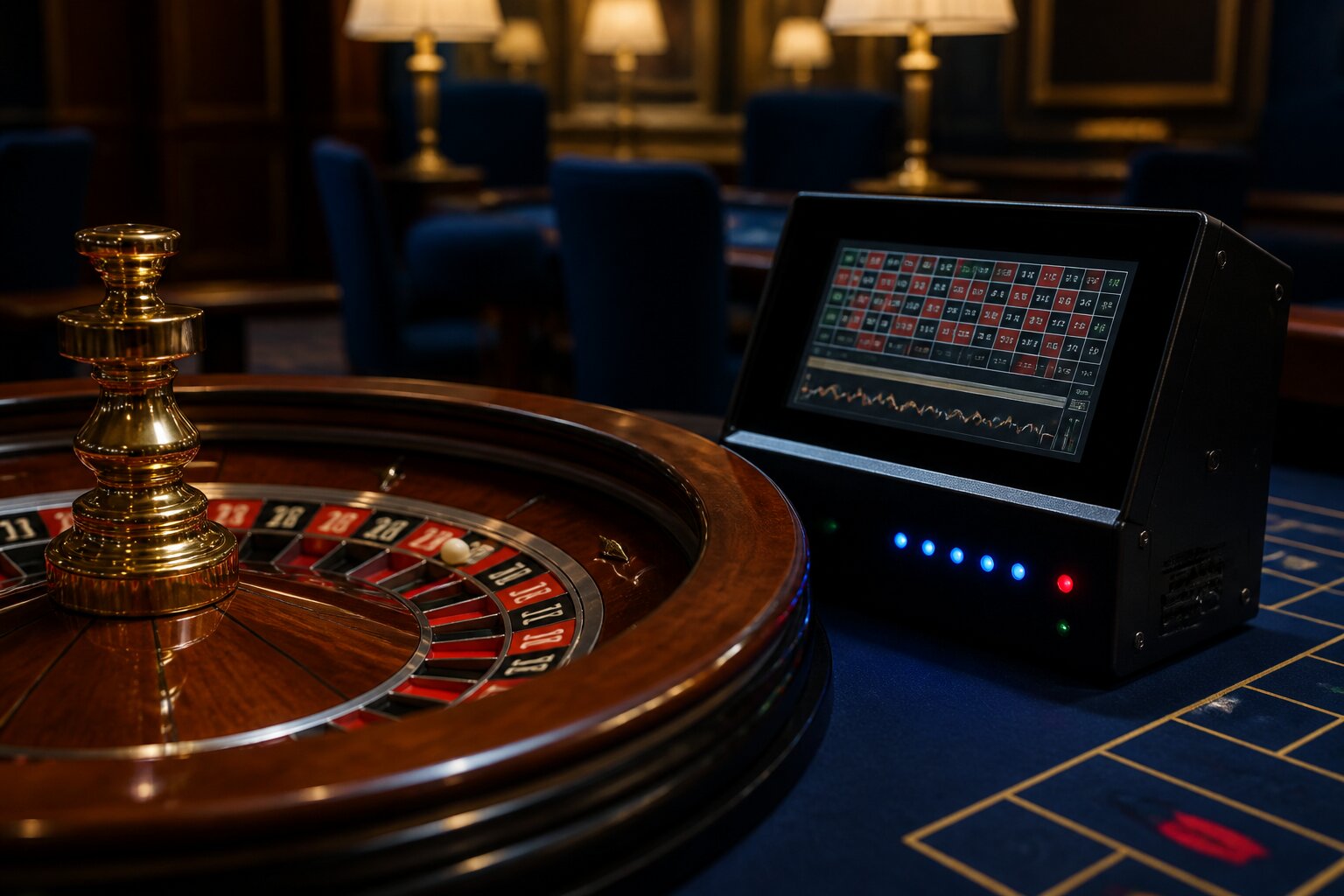
Picture the scene: you are standing by the roulette table, the wheel is spinning, and for a brief moment you wonder—could there really be a way to know where that white ball will land? Tales of clever gadgets and so-called roulette computers have circulated for decades, promising to read the motion of wheel and ball and turn the tables on the house.
The idea sounds almost cinematic: tiny devices hidden in a pocket, tapping in numbers, and whispering predictions for the next spin. Before anyone considers buying hi‑tech kit or chasing the notion of outsmarting the wheel, it is worth taking a closer look at what these devices claim to do and what reality looks like.
What follows examines how prediction devices are supposed to work, the laws and countermeasures that apply in the UK, and whether any system has ever delivered reliable results in a real casino environment.
What Is a Roulette Computer?
A roulette computer is a small electronic device designed to estimate where the ball might land on a spinning roulette wheel by recording key timings and running rapid calculations. The basic theory is straightforward: measure aspects of the spin, feed them into a model of motion and deceleration, and use the result to suggest a likely sector or group of numbers before bets close.
In practice such devices have taken many forms. Historical examples include wearable microcomputers sewn into clothing, toe‑activated switches that record timings, and discreet earpieces that relay a short signal. More recent attempts have used smartphones with custom apps and tiny sensors. In all cases the user must input timing information quickly and covertly during the very short interval of a spin.
Using these devices in a casino is prohibited and can carry serious consequences. The legal and operational risks are discussed in detail later, but for now bear in mind that even possession of unauthorised equipment can be treated as an offence in regulated venues. The next section looks at the mechanics behind the claims these gadgets make and how they attempt to turn motion into a prediction.
How Do Prediction Devices Claim to Work?
These devices present a blend of basic physics, timing and fast computation. The premise is that by measuring how quickly the ball and wheel are moving, and how they decelerate during a spin, it is possible to estimate where the ball will drop.
The usual workflow is compact and time‑pressured. The user records two or more time points during a spin—often by tapping a concealed switch each time the ball passes a fixed reference point on the wheel. With those inputs a small programme estimates ball and wheel speeds and projects where the ball will be relative to the wheel when it falls out of the rim. The output is generally a short signal indicating a sector rather than a single number, giving the player a narrow target for a bet.
Because the calculation window is tiny, these systems must balance measurement accuracy, modelling assumptions, and the time it takes to communicate a result to the player. That constraint shapes the device design and the kind of prediction it offers.
How Do Roulette Computers Analyse Spins?
In theory, analysis relies on repeated timing samples to estimate velocities and deceleration patterns. If the ball is timed as it passes a fixed point on successive revolutions, the device can infer its angular speed and how quickly that speed is dropping. The wheel’s rotation is measured similarly. From those figures a simple kinematic model projects the relative angular position when the ball is expected to depart the rim and hit the wheel’s pockets.
In practice there are several complicating factors. The ball’s deceleration is not perfectly uniform and can vary with where the croupier releases it, the angle of release, and slight irregularities on the wheel’s surface. Also, the point at which the ball leaves the rim and moves towards the pockets depends on tiny interactions with the frets and deflectors, which are inherently unpredictable. For these reasons, most devices provide a predicted sector rather than a precise number, and their claimed accuracy depends heavily on the degree of environmental control available.
What Technology Do These Devices Use?
Early systems used specialised microprocessors and bespoke wiring hidden on the body of the user. Control inputs were intentionally subtle: toe tappers, discreet thumb switches, or even small pressure sensors in footwear. Output methods ranged from short audio tones sent to an earpiece to vibration patterns indicating a sector on the wheel.
Modern attempts have sometimes adapted off‑the‑shelf hardware, such as smartphones with external sensors or modified apps, because these devices offer compact computing power and easy signal transmission. However, any additional hardware increases the visibility and detection risk, and many casinos now scan for unauthorised electronics.
Taken together, the method and technology show how tightly constrained any prediction scheme must be: measurements must be accurate, calculations fast, communication inconspicuous, and the whole process must avoid detection. The next section sets out the legal framework and consequences for attempting this in the UK.
Are Roulette Computers Legal in the UK?
No. Using a device to gain an advantage at a gambling table is unlawful under the Gambling Act 2005. That piece of legislation covers the use of any equipment or software to influence or predict the outcome of a gambling game, and operators treat such activity as cheating.
Consequences begin inside the venue: suspected users are likely to be stopped, searched and removed, with any connected funds withheld. Beyond that, the matter can lead to criminal prosecution, possible fines and a permanent criminal record. Casinos may also share details with other operators through exclusion schemes, making it difficult to return to play elsewhere.
To maintain a fair and regulated environment, operators invest in surveillance, staff training and equipment checks. Those protections make it very difficult to use a prediction device undetected for long. With the legal picture clear, the next question is whether, despite the risks, any of these devices can actually deliver reliable predictions in real play.
Can Roulette Computers Really Predict Roulette Outcomes?
Claims that roulette computers consistently predict outcomes do not stand up under realistic scrutiny. On paper, measurement and physics can give a probabilistic estimate of where the ball might land, but real casino conditions introduce several obstacles that typically negate any practical advantage.
First, modern casino wheels are routinely inspected and maintained to minimise mechanical bias. Even genuine small biases that might appear on older equipment are addressed quickly through maintenance and rotation of wheels. Second, croupiers vary the speed and angle of their spins intentionally and often without pattern, which undermines attempts to gather stable data from one spin to the next. Third, the short betting window leaves little time for detailed data input, complex computation and safe communication of the result.
Empirical testing and independent studies have shown that, under normal regulated conditions, any predictive gain is negligible compared with the house advantage and the variability of outcomes. Put simply, while some laboratory or contrived tests can produce promising results under tightly controlled conditions, those circumstances are not representative of a monitored casino floor. That reality undercuts the practical usefulness of these devices.
If certainty is rare, many of the claims made in marketing and anecdote fall apart on closer inspection, which is why myths and misconceptions persist—often divorced from the constraints of real play. The next section addresses some of those common misunderstandings directly.
Common Myths & Misconceptions About Roulette Devices
Stories of easy wins and foolproof gadgets are common, but most rest on selective or inaccurate accounts. One persistent myth is that wheels are simple to crack. While a poorly maintained wheel in the distant past might have shown bias, contemporary practice keeps equipment within tight tolerances and replaces or repairs parts before any pattern could be exploited.
Another frequent claim is that advanced devices sold online can guarantee winnings. In truth, products that promise certainty are either misrepresenting what their tech can do or are outright scams. Verifiable evidence is scarce, and independent tests that simulate real casino conditions rarely confirm the advertised performance.
There is also confusion about the mathematics involved. Even if a device could estimate where the ball might land in an idealised setting, probability still governs the outcome and small modelling errors amplify quickly. Casinos deliberately create conditions — variable spins, rapid closing of bets and vigilant staff — that reduce the window where a predictive model could have value.
Finally, the idea that sophisticated surveillance systems cannot detect gadget use is misleading. Casinos combine human observation with camera analytics and betting pattern monitoring to flag unusual activity. Given that, attempts to use unauthorised technology carry a high likelihood of detection and ensuing consequences.
Having covered the myths, the final section outlines the practical risks, the penalties involved and the kinds of countermeasures venues use to protect game integrity.
Risks, Penalties & Casino Countermeasures
The risk of engaging with roulette computers is substantial and multi‑faceted. Legally, the Gambling Act 2005 criminalises the use of devices to gain an unfair advantage, so prosecution and fines are real possibilities. Operators also pursue civil remedies and will confiscate any winnings linked to suspected misconduct.
Operationally, the immediate outcome in a casino is severe. Security teams act to prevent further play, and venues maintain information-sharing arrangements so that exclusions can extend across the industry. Even if criminal charges do not follow, being barred from multiple venues and having one’s details circulated presents a lasting personal cost.
Casinos have layered defences designed to deter and detect gadget use. These include high‑resolution cameras focused on both the wheel and players, staff trained to recognise suspicious movement and equipment, randomised wheel rotation and seating configurations that make covert timing difficult, and software systems that analyse unusual betting patterns in real time. Regular technical inspections of wheels and ball tracks are part of routine maintenance to remove any mechanical advantages.
Given the legal exposure, the likely loss of access to venues and the strong operational safeguards, attempting to use a roulette computer is not a viable strategy. Play is best approached with an understanding of how games are regulated and how operators protect fairness. If you want to weigh options for playing, the site’s comparisons and guidance can help you make informed choices that fit your interests and circumstances.
While the idea of a roulette computer is an intriguing piece of gambling folklore, the combination of legal prohibition, rigorous casino countermeasures and the practical limits of measurement and modelling means these devices are not a dependable way to alter outcomes in a real, regulated environment.
Play Casino Games at Freebet Casino
We invite you to enjoy the buzz of playing casino games with us at Freebet Casino. Explore all the fun and excitement our games has to offer in a relaxed setting where everyone is welcome.
**The information provided in this blog is intended for educational purposes and should not be construed as betting advice or a guarantee of success. Always gamble responsibly.