
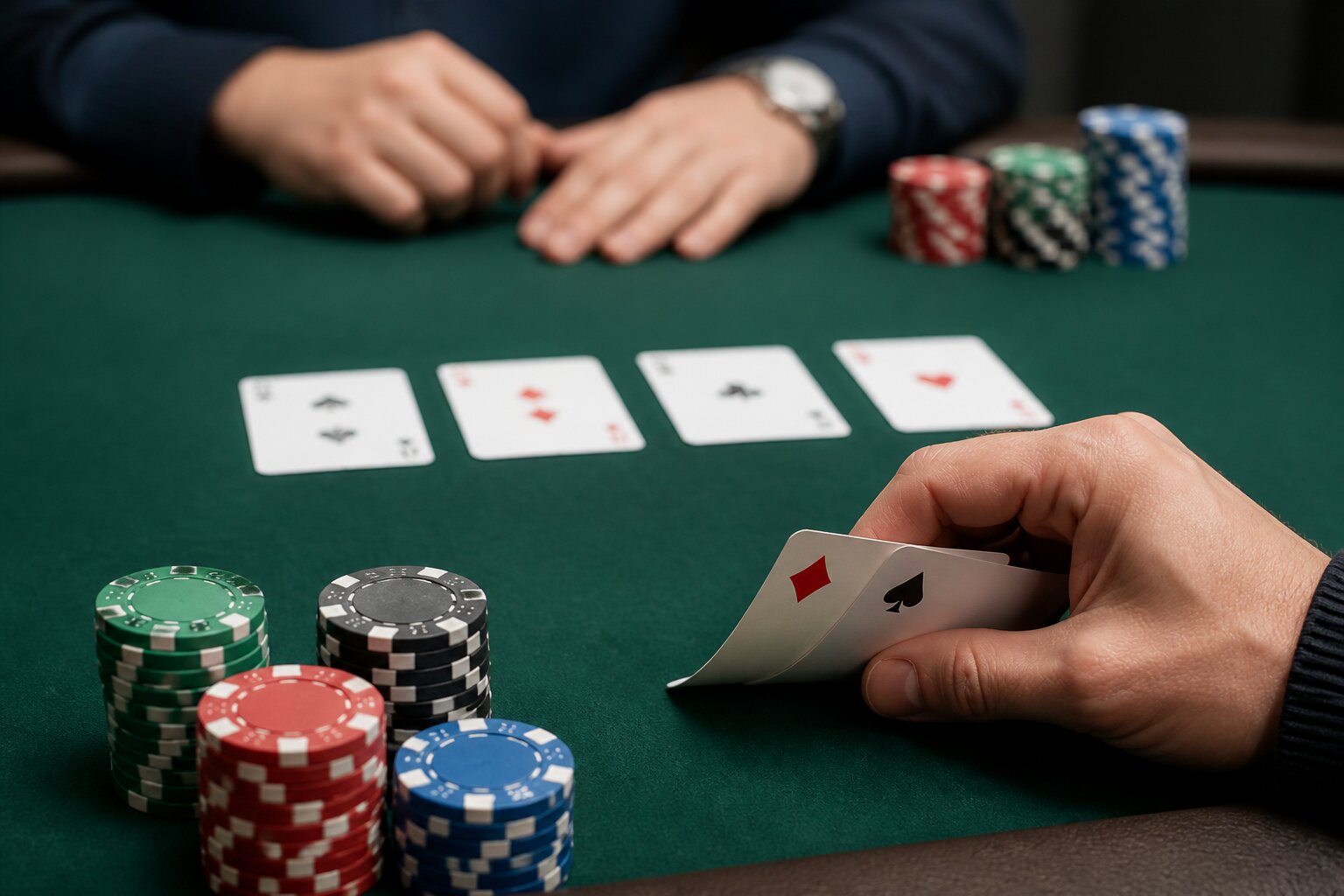
Curious about what an “overcard” means in poker? You’re not alone — this term comes up a lot at the tables, and understanding it can sharpen your decision-making.
Whether you’re new to poker or polishing your skills, grasping overcards helps you judge how a hand might develop and where it fits within the wider card picture.
Ready to cut through the jargon and spot overcards with confidence? Read on for clear definitions, practical examples and notes on how overcards interact with different poker variants.
What Does Overcard Mean in Poker?
An overcard is any card in your hand that ranks higher than the highest card showing among the community cards, often called the board. For instance, if the board shows 8, 9 and 4, a Queen or King in your hand would be an overcard because it is higher than any card on the board.
Holding an overcard signals the potential to make a higher pair than what the board currently offers, but it is not itself a completed hand. Its value depends on how the remaining community cards fall and how other players behave during the betting rounds.
Bear in mind that overcards are one factor among many: position, betting patterns and the visible board all help you assess whether to stay in or fold.
Understanding Overcards in Different Poker Variants
You will encounter overcards in many poker variants, though how they matter depends on each game’s rules.
In Texas Hold’em, each player gets two hole cards. Any hole card higher than the top card on the board is an overcard and can pair up to form a higher pair than what’s currently possible from the community cards.
Omaha deals four hole cards to each player, but the rule that exactly two hole cards must be used with three community cards means you may have several overcards in your hand yet can use only two to make a final hand. That changes how you weigh those cards compared with Hold’em.
Other poker games follow their own card-usage rules, but the basic idea stays the same: compare your private cards to the board to see if they sit above the highest public card.
How Do Overcards Affect Hand Rankings?
Overcards do not alter official hand rankings — a pair still ranks below two pair, and so on — but they influence your potential to reach those ranks. If you hold an Ace and the highest board card is a Ten, that Ace gives you the chance to make a top pair should another Ace appear.
The practical effect of overcards comes down to probabilities and the betting context. An overcard’s value rises if opponents are showing weakness or the pot odds justify calling for the chance to improve. Conversely, strong betting on later streets can indicate that even if you catch a pair, it may not be enough.
So, while overcards offer opportunities, they must be assessed alongside board texture, opponent tendencies and pot size.
Common Misconceptions About Overcards
A frequent mistake is assuming overcards automatically make a hand strong. They only provide the potential to improve; until that improvement happens, your hand may still be behind others.
Players sometimes treat overcards as a cue to play aggressively, but this can backfire if the betting suggests opponents already have made hands. Reading the table and noting how others act will often tell you more than the mere presence of high cards.
Another misconception is that overcards are rare or especially valuable on their own. In many games they appear regularly, and their real worth depends on how the flop, turn and river complete or fail to complete your hand relative to what opponents are showing.
Why Are Overcards Important in Poker?
Overcards help you understand possible hand developments and your standing in a given round. If you hold one or two overcards, it changes the combinations that could form and how opponents might respond when the next cards arrive.
Knowing whether your private cards are overcards also aids in range construction: it helps you imagine what hands opponents might hold and whether you can realistically beat them if certain cards fall. That awareness supports better decisions about when to stay in and when to fold.
Used alongside positional awareness and betting patterns, overcards become a practical tool for judging risk and reward during play.
Overcards vs. Undercards: What’s the Difference?
The distinction is simple: overcards are higher than the top community card; undercards are lower than the lowest community card. For example, if the board’s highest card is a Jack and you hold a Queen, that Queen is an overcard. If the board’s lowest card is a 9 and you hold a 7, that 7 is an undercard.
Overcards present the possibility of forming higher pairs than the board allows; undercards cannot generate pairs that outrank what’s already visible. Both labels are descriptive tools players use to evaluate their hand potential relative to the board.
Understanding this difference helps with reading the table and anticipating how future cards might change the hand landscape.
Recognising Overcards at the Table
Spotting overcards quickly requires a simple comparison between your hole cards and the board. Take a moment after the flop to check which of your cards sit above the highest community card — that will tell you whether you hold overcards and how many outs you might have to improve.
This habit of comparing cards becomes automatic with practice and improves the speed and quality of your in-play assessments. It also helps you judge how aggressively to respond to betting:
- multiple overcards in hand can be more valuable in certain board contexts, for example when they are both live and not blocked by opponents’ visible cards
- a single overcard has fewer outs and often calls for more caution unless pot odds or reads justify action
- overcards rarely warrant blind aggression without supporting reads, position or favourable pot odds
When you have overcards, count your outs and remember they are not guarantees. For example, two overcards to a Jack on the board give you up to six outs to hit a pair on the turn or river, but that number falls if opponents’ action or a paired board reduces live cards. Including this quick outs count in your routine helps you compare chances of improving with the price to call.
Examples of Overcards in Popular Poker Games
Below are brief examples that show how overcards look in different games and why the game rules matter when assessing them.
Texas Hold’em Example
If the community cards are 6♣, 9♦ and J♠ and you hold K♠ and Q♦, both your cards are overcards because they are higher than the Jack on the board. That gives you chances to pair up and potentially form a hand that beats board-made pairs. Bear in mind that the number of clean outs can be reduced by opponent action, card removal effects, or if the board pairs.
Omaha Example
With a board of 8♥, 5♠ and 2♦ and hole cards A♣, J♥, 10♦ and 7♠, the Ace and Jack are overcards relative to the highest board card, 8. Remember that in Omaha you must use exactly two hole cards with three community cards to build your final five-card hand, so you weigh which two overcards to combine with the board. Also consider that having four hole cards creates more combination complexity and more chances at blockers or hidden strength for opponents.
Seven-Card Stud Example
If your visible cards are 7♠ and 4♥ while another player’s upcards include a 10♦, that 10 is an overcard versus the lower cards you have visible. In stud games the varying number of exposed cards changes how players judge threats and potential improvements. Visible cards give information about opponents’ likely holdings and reduce uncertainty, so treat overcards shown by others as stronger signals than in blind games.
These examples show how overcards appear across formats and why rules about card usage shape their practical value. Recognising the context, counting realistic outs and factoring in opponents’ visible cards or betting behaviour will improve your decisions when you hold overcards.
Summary of Key Overcard Concepts
To close, here are the main points to take away about overcards and how they fit into poker play.
Overcards are private cards that rank above the highest community card and indicate potential to make higher pairs. They appear across poker variants, but their significance depends on each game’s rules and the betting situation. Reading the board, noting opponent behaviour and understanding pot context are all necessary to judge how much weight to place on overcards.
Use this knowledge to inform your decisions at the table, and pair it with sensible bankroll management and self-control. Keep learning, and apply what you’ve read here to make clearer, more confident choices in play.
**The information provided in this blog is intended for educational purposes and should not be construed as betting advice or a guarantee of success. Always gamble responsibly.