
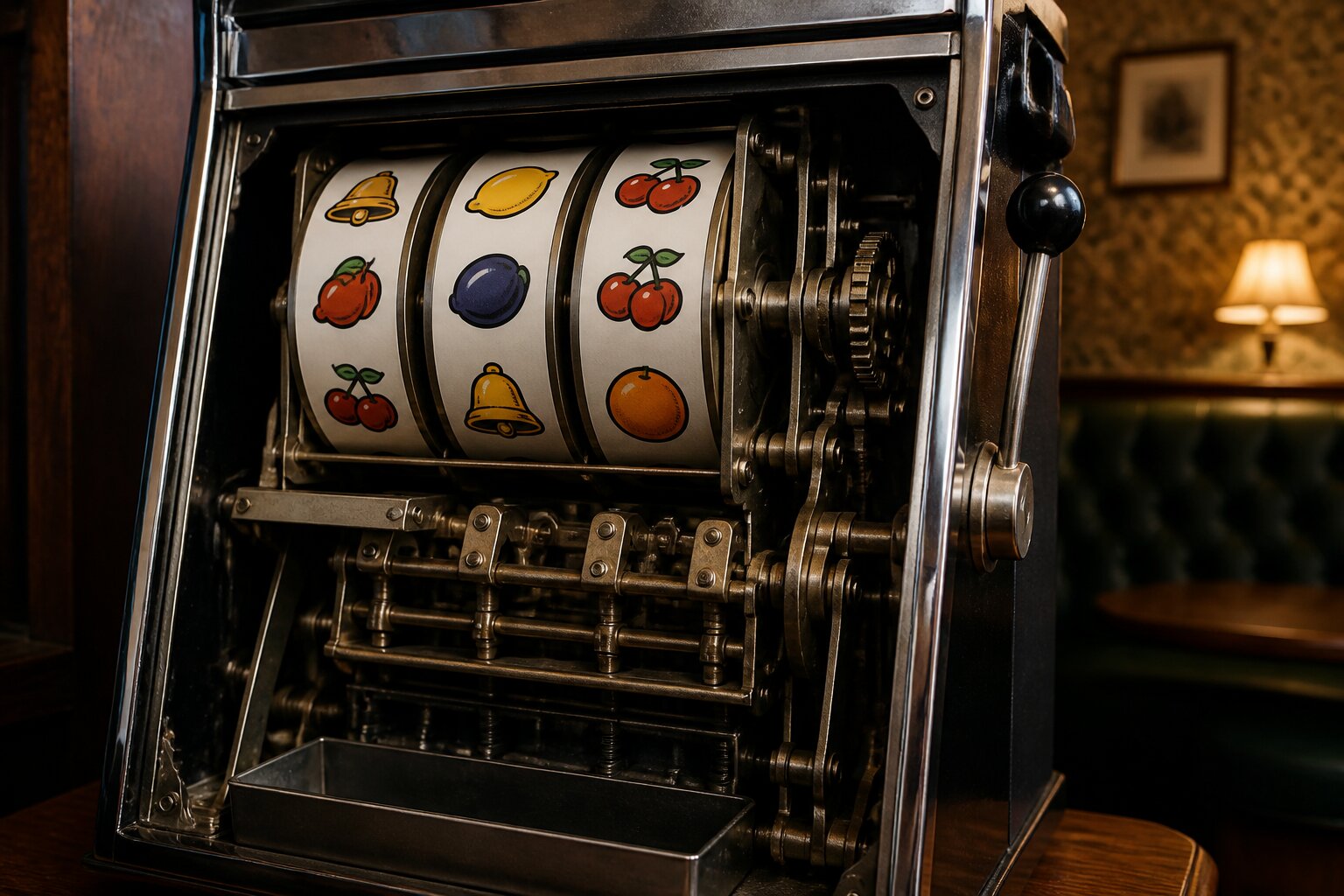
Ever watched a slot machine’s reels spin and wondered what’s really going on inside? Before video screens and digital sounds took over, the halls of Britain’s casinos and arcades were filled with the distinct clunk of levers and the satisfying whir of spinning reels.
Mechanical slot machines were once the beating heart of arcade fun, their chrome casings and fruit symbols becoming a familiar sight on the high street and at seaside piers. Even now, the physicality of pulling a handle and feeling the machine respond has a particular appeal that draws people in.
So what makes those old‑school machines tick? Beneath the glass and chrome is a network of engineering and designed randomness that decides every outcome; the next section looks inside one of these classic machines to show exactly how those parts fit together.
What Is a Mechanical Slot Machine?
A mechanical slot machine is a gaming device built from moving parts rather than microchips or on‑screen graphics. Often called “one‑armed bandits”, these machines use a lever on the side to set physical reels spinning. The reels themselves are metal cylinders marked with symbols such as bells, bars, lemons and cherries.
Everything you hear and see on a true mechanical machine comes from hardware: the lever, the rotation of the reels, the notches that stop them and the coins that clatter into the payout tray. There are no programmed animations or software outcomes to create the effects; the sensations are entirely mechanical.
These machines were designed for straightforward operation and durability. Where modern machines use electronic systems and random number generators, original mechanical models rely on gears, springs and stoppers to produce a random result every spin. In the next section, we break down those internal parts so you can see how they combine to make the machine work.
Inside a Mechanical Slot: Core Components
Inside a mechanical slot is a compact arrangement of parts, each with a clear job to perform. The most visible elements are the reels: usually three or four metal cylinders fitted on a central axle and decorated with the familiar fruit and bar symbols.
The lever, or “one arm”, releases a wound spring or other stored energy that sets the reels in motion. That resistance and movement form much of the tactile experience players recall. As the reels spin, a set of gears, cams and stoppers interact to slow and eventually halt each reel independently. Springs and locking latches bring the motion to a precise stop so the visible symbols can be read.
Behind the display, notched discs or cams register the reel positions. Metal feelers or arms detect which symbols are showing and engage the payout linkage if they form a recognised winning pattern. The coin hopper and payout chute then deliver physical coins into the tray at the front of the machine, completing the cycle.
This network of parts is engineered so the mechanism functions reliably without electronics. The next section explores how that mechanical motion is responsible for producing a random result each time the lever is pulled.
How Do Mechanical Slot Machines Generate Random Results?
Mechanical slot machines create randomness using the interaction of physical forces and finely tuned parts. When the lever is pulled, stored energy pushes the reels into motion. Each reel’s stopping point is determined by the moment a mechanical stopper engages a notch on the reel’s edge.
Small variations in how the lever is pulled, tiny differences in friction, slight imbalances and the precise timing of stoppers all mean that the exact position a reel settles in cannot be predicted in advance. Because these variables change from spin to spin, outcomes remain effectively random within the machine’s mechanical design.
To illustrate: if a three‑reel machine has 20 symbols on each reel and only one of those symbols is visible when the reel stops, the mathematical chance of a particular three‑symbol alignment can be calculated from those counts. The machine’s design — how many stops, which symbols are repeated on a reel, and how the stoppers engage — determines those odds.
This randomness arises from physics and engineering rather than software. With that in mind, the following section explains how the machine recognises a win and turns that mechanical result into a payout.
Payout Mechanisms: How Wins Are Determined
Once the reels come to rest, the machine’s sensing components check which symbols are showing. Notched cams or discs behind each reel align with mechanical feelers that identify the reel positions and compare them to the machine’s pre‑set winning combinations.
If a recognised combination appears, a linkage in the mechanism releases a catch on the coin hopper. The hopper is a secure container holding coins; when a release occurs, the appropriate number of coins drops down a chute into the player’s tray. Payouts are fixed by the internal design — certain combinations equate to specific coin amounts, with larger matches triggering larger releases.
This process is entirely automatic and physical: there is no decision‑making beyond the way the mechanism has been built. The amount paid and the conditions for a payout are all determined when the machine is manufactured and set up. Having seen how outcomes are sensed and paid, the next section contrasts these machines with modern digital slots to highlight how the player experience differs.
How Are Mechanical Slots Different from Modern Digital Slots?
The difference between mechanical and modern digital slots is one of hardware versus software. Mechanical machines use real reels, levers and payout hoppers; the player interacts with tangible parts and watches physical symbols move. Modern slots present animated reels on screens and use random number generators (RNGs) — software systems that determine results and then display corresponding graphics.
Digital machines can offer features impossible in a purely mechanical format: animated bonus rounds, stacked wilds, varying paylines and progressive jackpots that link multiple machines. Electronic sensors and software also allow much finer control over odds and payout rates, and these elements can be updated or changed without altering physical components.
Despite these technical differences, both formats are designed so players cannot influence the outcome through skill. The following section traces how this technology developed and how mechanical models fit into that history.
History & Evolution of Mechanical Slot Machines
Mechanical slot machines date back to the late 19th century, with early designs establishing the three‑reel layout and the familiar symbol set. These early machines were robust, metal‑cased devices intended for use in public houses and amusement venues.
In the mid‑20th century, fruit machines became a staple of British seaside arcades, offering simple coin‑operated play with clear visual symbols. The arrival of electromechanical models in the 1960s and 70s added basic electronic features such as lights and automatic payouts while retaining physical reels. Over time, full electronic and then fully digital machines took over, providing more varied gameplay and easier maintenance.
Mechanical machines remain important as cultural and technological milestones: they show how straightforward engineering produced engaging entertainment long before screens and software dominated the industry. The next section answers a couple of common questions players still have about these classic machines.
Common Questions About Playing Mechanical Slot Machines
Mechanical slot machines are the subject of many questions, particularly from those who remember them fondly or encounter preserved examples today. Below are clear answers to two of the most common queries.
Are Mechanical Slots Still Found in Casinos?
Genuine, fully mechanical slot machines are now uncommon on modern gaming floors, which primarily use electronic and digital models. However, some traditional arcades and heritage attractions—especially in seaside towns—may keep working examples for display or limited play. In most licensed gambling venues you will encounter newer, electronic machines rather than original mechanical units.
Can You Influence the Outcome?
No. A mechanical slot’s outcome is the result of its engineered moving parts and the randomness that arises from their interaction; player actions cannot control where the reels will stop. That design ensures consistent odds for every player and underlines the importance of setting personal limits before playing. If wanting to explore other machines, consider comparing options and features to find one that suits your preferences.
Play Online Slots at Freebet Casino
Fancy exploring something new for a bit of fun? We’d love for you to join us and enjoy the excitement of online slots at Freebet Casino.
Creating an account only takes a moment, then you can make a deposit and choose from our games whenever you fancy. We look forward to seeing you spin the reels with us soon.
**The information provided in this blog is intended for educational purposes and should not be construed as betting advice or a guarantee of success. Always gamble responsibly.